✍️ Handwriting
Handwriting is defined as the skill of forming letters and numbers correctly, legibly, and fluently. It includes print (manuscript) and cursive styles and is taught through structured practice.
Purpose:
- Develop fine motor control.
- Build the physical ability to write.
- Lay the foundation for copywork and written expression.
📖 Copywork
Copywork is defined as the intentional practice of copying well-written sentences, poetry, Scripture, or prose from a model onto paper, focusing on accuracy, penmanship, spelling, punctuation, and exposure to quality language.
Purpose:
- Train the hand and the eye.
- Internalize excellent language patterns.
- Reinforce spelling and grammar in context.
- Develop attention to detail and neatness.
Copywork is not busywork—it is gentle yet powerful language training.
🗣️ Dictation
Dictation is defined as the practice of writing a previously studied passage from memory as it is read aloud by the teacher, testing the student’s ability to recall correct spelling, punctuation, capitalization, and sentence structure.
Purpose:
- Reinforce grammar, mechanics, and spelling through real literature.
- Train attention, auditory memory, and listening skills.
- Transition from copywork to original composition.
Progression:
- Studied dictation (the child studies the passage first).
- Prepared dictation (discussed but not memorized).
- Unprepared dictation (for advanced students only).
🌱 Preschool–Kindergarten
Goal: Build fine motor strength, letter recognition, and pre-writing skills.
🔹 Focus:
- Tracing lines and shapes.
- Uppercase letter formation.
- Name writing.
🔹 Step-by-Step:
- Finger Tracing: Trace large letters in sand, salt trays, or on textured cards.
- Line Practice: Use worksheets or draw straight, curved, and zigzag lines.
- Letter Tracing: Use dotted-line uppercase letters on wide-ruled paper.
- Name Practice: Child traces then copies their name in print.
🔹 Adaptations:
- Motor delay: Use chunky crayons or pencil grips.
- Dysgraphia: Start with vertical surfaces (chalkboard, easel).
- Attention issues: Keep lessons under 5 minutes and use timers or songs.
- Visual tracking: Use highlighted tracing lines and bold start/stop dots.
📘 Grades 1–3
Goal: Master manuscript print, introduce cursive, and begin simple copywork.
🔹 Focus:
- Print fluency (1st–2nd), Cursive introduction (2nd–3rd).
- Daily short copywork (1–3 sentences).
🔹 Step-by-Step:
- Print Practice: Copy one letter/word at a time using model lines above.
- Cursive Introduction (2nd+): Learn one letter at a time with directional arrows.
- Copywork: Start with short proverbs, lines from readers, or Scripture (if desired).
- Self-Check: Encourage comparison with the model—1–2 improvements.
🔹 Adaptations:
- Slow processing: Let the child say letters aloud as they write.
- ADHD: Use finger tracing before writing and incorporate movement breaks.
- Autism: Use high-interest sentences and scripts from stories.
- Dyslexia: Use color-coded strokes for letters (e.g., upstrokes in red, downstrokes in blue).
📗 Grades 4–6
Goal: Solidify cursive, increase copywork length, and transition into dictation.
🔹 Focus:
- Copy 1–2 paragraphs per week.
- Begin transcription (reading from one place, writing in another).
- Light dictation (single sentence).
🔹 Step-by-Step:
- Cursive Mastery: Daily copywork in cursive from living books.
- Paragraph Copywork: Focus on neatness, punctuation, and correct spelling.
- Transcription Practice: Child copies from book to notebook.
- Simple Dictation: Parents read short sentences aloud; a child writes from memory.
🔹 Adaptations:
- Executive function challenges: Break tasks into numbered steps.
- Memory issues: Use close exercises for copywork (missing words filled in).
- Hand fatigue: Allow typing or use voice-to-text with follow-up editing practice.
📙 Grades 7–9
Goal: Independent copywork and structured dictation with grammar and style awareness.
🔹 Focus:
- 1–2 dictation passages per week.
- Copywork becomes a study of language, punctuation, and style.
🔹 Step-by-Step:
- Pre-Dictation Study: Read and orally discuss the passage.
- Visual Copy: Copy as neatly as possible; correct errors.
- Dictation Day: A parent reads the passage once; the child writes it from memory.
- Editing: Compare and correct using colored pens.
🔹 Adaptations:
- Working memory issues: Break dictation into chunks.
- Dyslexia: Use audio support or visual chunking.
- Autism: Let the child pick copywork from favorite authors or books.
📕 Grades 10–12
Goal: Apply copywork and dictation toward composition and rhetorical writing.
🔹 Focus:
- Literary and rhetorical style analysis.
- Advanced dictation with longer passages.
- Imitation exercises (writing in the style of an author).
🔹 Step-by-Step:
- Literary Copywork: Choose beautiful or meaningful passages weekly.
- Advanced Dictation: Use full paragraphs with punctuation and dialogue.
- Imitation Exercises: Rewrite a passage in the same voice but new context.
- Written Narrations: Transition into essays and reflections.
🔹 Adaptations:
- Processing disorders: Provide audio versions and typed models.
- Handwriting pain: Use computers but still check for grammar and syntax.
- Executive dysfunction: Use checklists and visual reminders of steps.
📅 Weekly Progression (Grades 1–6)
Goal: Build fluent, legible handwriting, internalize strong language patterns, and gently prepare for original writing through daily exposure to excellent literature and careful attention.
Day 1 – Copywork – Guided
- Read aloud a short passage (1–2 sentences for younger, 3–5 for older).
- Discuss punctuation, capitals, any tricky words.
- Child copies the passage carefully in print or cursive.
- Adaptations:
- Highlight tricky words ahead of time.
- Provide tracing versions for struggling writers.
- Allow choice of pencil or marker for sensory needs.
Day 2 – Copywork – Independent + Oral Dictation
- Review and re-read Monday’s passage.
- Child copies independently.
- Then do oral dictation: dictate one phrase and have the student repeat aloud (not write).
- Adaptations:
- Use a visual model on the desk.
- Read one word at a time if needed.
- Allow movement breaks between lines.
Day 3 – Copywork or Tracing + Mechanics Focus
- Provide a new short passage (or repeat an old one).
- Focus on one skill: capital letters, spacing, punctuation, or correct letter formation.
- Adaptations:
- Use sand trays, whiteboards, or textured letters for sensory input.
- For dysgraphia: dictate the sentence and let the child type it instead.
Day 4 – Prepared Dictation or Picture Narration
- Re-read a well-known passage from the week.
- Dictate one sentence slowly, word by word. Child writes from memory.
- Younger or struggling children can draw a picture of the sentence or story and explain it orally.
- Adaptations:
- Break up the sentence into 2–3 word chunks.
- Allow use of phonetic spelling for early writers.
- Use voice-to-text if writing is too difficult.
📅 Weekly Progression (Grades 7–12)
Goal: Transition from teacher-directed copywork and dictation into independent mastery of language, grammar, spelling, and style—ultimately preparing the student for original composition and rhetorical writing.
Day 1 – Literary Study + Copywork
- Read aloud or silently a selected passage (from literature, speeches, historical texts).
- Discuss style, vocabulary, punctuation.
- Copy 1–2 paragraphs in best handwriting or type.
- Optional adaptation:
- Use audio recordings or color-coded printouts for dyslexia or visual tracking issues.
Day 2 – Prepared Dictation
- Review the same passage.
- Talk through punctuation, tricky spellings, grammar points.
- Dictate the passage slowly (1 clause at a time), child writes from memory.
- Adaptation:
- Use shorter chunks, allow re-reading of each phrase for working memory support.
Day 3 – Editing + Imitation Practice
- Child compares their dictation to the model.
- Use colored pens to fix spelling, punctuation, or formatting errors.
- Optional:
- Imitation exercise — write a new paragraph in the same style or tone (e.g., rewrite from another character’s point of view).
- Adaptation:
- Offer scaffolded models (e.g., sentence frames) for autistic or ADHD learners.
Day 4 – Written Narration or Freewriting
Choose from:
- Respond to the copywork passage.
- Narrate a history reading.
- Write a short reflective or persuasive paragraph.
- Focus on ideas and clarity more than mechanics.
- Adaptation:
- Allow use of typing or dictation software for those with handwriting fatigue or dysgraphia.
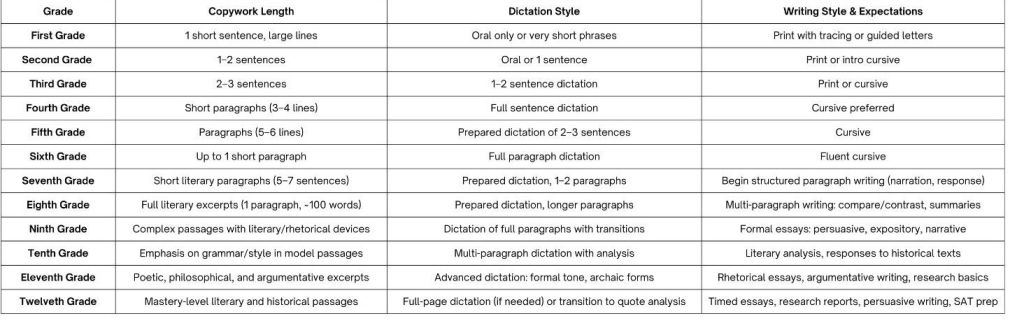
✨ Grade-by-Grade Expectations (Grades 1-12)