Briarwood Hollow Curriculum, Charlotte Mason Method, Family-Style Learning, Homeschool, Homeschool Tips

Book Substitute Rules

So you are never stuck with a book that doesn’t work

Charlotte Mason–aligned • Neurodivergent-friendly • Guilt-free

THE CORE PRINCIPLE (READ THIS FIRST)

If the book is not producing attention, narration, or connection, it is not doing its job.

A book that flops is not a failure.
It is simply information packaged the wrong way.

You are allowed—required, even—to replace it.

THE 3-NON-NEGOTIABLES OF A GOOD SUBSTITUTE

Any replacement book must meet at least ONE of these:

  1. Narrative-driven (story, biography, strong voice)
  2. Visually supportive (pictures, diagrams, timelines)
  3. Auditory-friendly (audiobook, strong read-aloud flow)

If it meets none → skip it.

WHEN TO SUBSTITUTE (NO WAITING)

Substitute immediately if:

  • Eyes glaze over within 5–10 minutes
  • Narration produces nothing or distress
  • Anxiety or shutdown appears
  • You dread opening the book

You do not push through for weeks.

WHAT MUST STAY THE SAME

When substituting, keep the topic, not the book.

Examples:

  • Ancient Egypt → still Ancient Egypt
  • Body systems → still body systems
  • American Revolution → still American Revolution

The book topic stays constant.
The delivery changes.

ACCEPTABLE SUBSTITUTION TYPES (RANKED)

Tier 1: Same Topic, Different Format (Best)

  • Picture-book nonfiction
  • Graphic nonfiction
  • DK / Usborne browsing books
  • Short documentary clips (5–10 min)

Tier 2: Same Era or Concept

  • Historical fiction instead of nonfiction
  • Biography instead of overview
  • Single-event focus instead of survey

Tier 3: Read-Aloud Only Exposure

  • You read and summarize
  • Child listens while drawing or building
  • No narration required that day

All tiers count as valid learning.

HOW MANY BOOKS IS “ENOUGH”?

For each topic block:

  • Minimum: 1 good book
  • Ideal: 2–3 varied formats
  • Maximum: Stop when narration is strong

More books ≠ more learning.

THE “48-HOUR RULE”

If a book hasn’t connected after:

  • 2 readings or
  • 48 hours of avoidance

→ Replace it without discussion.

No explanations to children required.

SPECIAL RULES FOR NEURODIVERGENT FAMILIES

Dyslexia

  • Prefer oral + audio
  • Written-heavy books are optional

ADHD

  • Short chapters > long spines
  • Stop mid-chapter if attention dips

Autism & Anxiety

  • Predictable structure
  • Preview what the book is about
  • No surprise questioning

Memory Challenges

  • Repetition across formats
  • Same topic, different books

SUBSTITUTION DOES NOT REQUIRE:

  • Matching reading level exactly
  • Finishing the original book
  • Justifying your choice
  • “Making up” missed pages

QUICK DECISION FLOW

  • Is attention present?
  • Is narration possible (in any form)?
  • Is stress low?

If no to any → substitute.

THE MOST IMPORTANT RULE

The right book makes teaching easier, not harder.

If it makes your day heavier, it’s the wrong book—for now.

You can always come back to it in the next 4-year cycle.

This rule set is designed to protect learning, attention, and your sanity.

Briarwood Hollow Curriculum, Charlotte Mason Method, Curriculum, Family-Style Learning, Homeschool, Shared Spines, Special Needs Curriculum

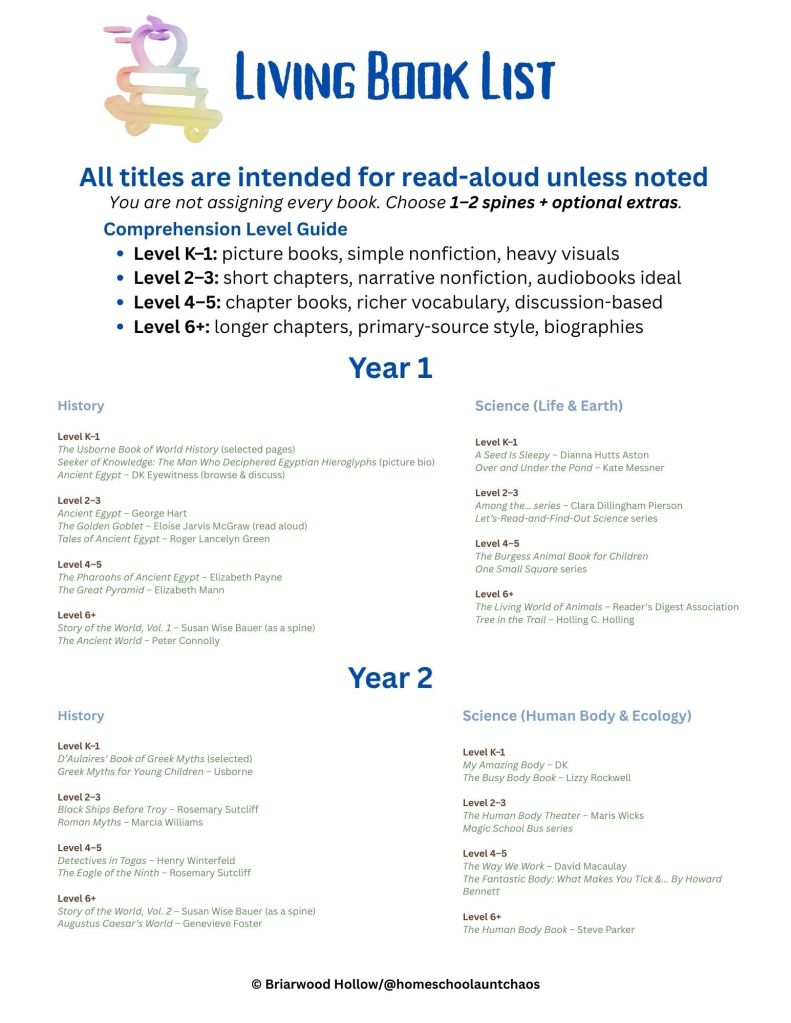
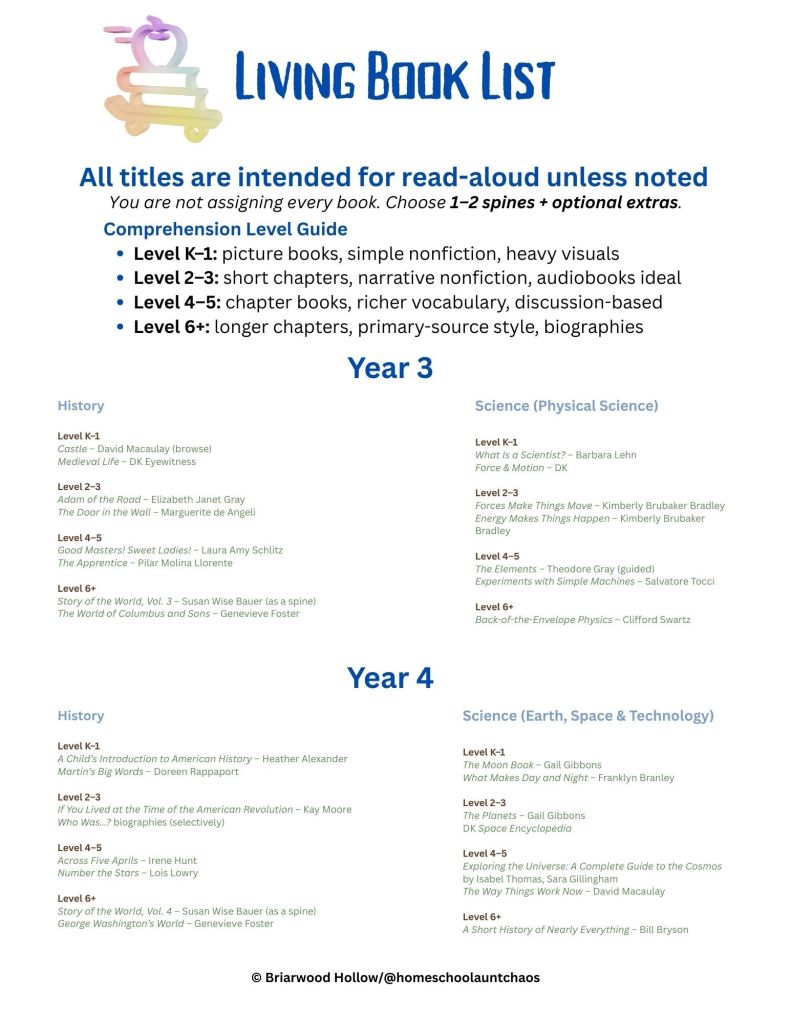
Living Book List

All titles are intended for read-aloud unless noted

You are not assigning every book. Choose 1–2 spines + optional extras.

COMPREHENSION LEVEL GUIDE

Level K–1:

  • picture books, simple nonfiction, heavy visuals

Level 2–3:

  • short chapters, narrative nonfiction, audiobooks ideal

Level 4–5:

  • chapter books, richer vocabulary, discussion-based

Level 6+:

  • longer chapters, primary-source style, biographies

Book Lists

IMPORTANT NOTES

  • Audiobooks are strongly encouraged
  • Picture books are valid at all ages
  • Re-read favorites each cycle
  • One excellent book > many mediocre ones

Living books are meant to be loved, not rushed.

How to use this without overwhelmed

  • Pick 1 history spine + 1 science spine per year
  • Add picture books freely, even for teens
  • Use audiobooks whenever attention or decoding is a barrier
  • Re-read favorites every cycle (that’s a feature, not a failure)

This setup is ideal for children:

  • Dyslexia → oral + audio
  • ADHD → narrative-driven books
  • Autism → predictable themes, repeated exposure
  • Memory challenges → revisiting the same content every 4 years

Briarwood Hollow Curriculum, Curriculum, Homeschool, Learning

Sensory Specimen Box

What Is a Sensory Specimen Box?

A curated collection of physical items students can handle, observe, compare, and investigate to deepen understanding of academic concepts through sensory input.

Best for:

  • Science & nature study
  • Language arts (descriptive writing, vocabulary)
  • History & geography
  • Special education & neurodivergent learners
  • Inquiry-based and Montessori-style learning

Core Components (All Grade Levels)

Each box typically includes:

  • Specimens (natural or manmade objects)
  • Magnifying glass
  • Observation cards or journal pages
  • Labels or classification cards
  • Optional tools (scale, ruler, tweezers, sound recorder)

Grade-Level Ideas

🟢 K–2: Explore & Describe

Focus: Curiosity, language, basic science

Specimens:

  • Pinecones, feathers, shells
  • Smooth vs. rough stones
  • Fabric swatches
  • Seeds or beans

Activities:

  • Sort by texture, size, or color
  • Describe using 5 senses
  • Draw and label

🔵 3–5: Compare & Classify

Focus: Observation skills, early scientific thinking

Specimens:

  • Leaves from different trees
  • Insect models or exoskeletons
  • Fossils or fossil replicas
  • Minerals

Activities:

  • Create Venn diagrams
  • Measure and record data
  • Write detailed descriptions
  • Introduce taxonomy basics

🟣 6–8: Analyze & Investigate

Focus: Systems, cause/effect, scientific method

Specimens:

  • Igneous vs. sedimentary rocks
  • Animal fur samples (ethically sourced)
  • Soil types
  • Historical artifacts (replicas)

Activities:

  • Hypothesis testing
  • Compare structure & function
  • Cultural or environmental connections
  • Lab-style notebooks

🔴 9–12: Evaluate & Synthesize

Focus: Critical thinking, real-world application

Specimens:

  • Microscopic slides
  • Industrial materials (metals, polymers)
  • Archaeological replicas
  • Forensic samples (fibers, soil)

Activities:

  • Research-based analysis
  • Cross-disciplinary projects
  • Forensic or environmental case studies
  • Technical writing & presentations

Themed Sensory Specimen Boxes (All Ages)

You can rotate boxes by unit:

  • 🌿 Ecosystems Box
  • 🧬 Human Body Box
  • 🏺 Ancient Civilizations Box
  • 🧭 Geography & Cultures Box
  • 🔬 Scientific Tools Box

Adaptations for Sensory Needs

  • Provide gloves or tools for touch-sensitive students
  • Include sound-only or visual-only specimens
  • Offer choice-based exploration
  • Use calming textures or weighted items

Safety & Practical Tips

  • Avoid allergens (nuts, strong scents)
  • Clearly label fragile or sharp items
  • Use sealed containers for biological samples
  • Include a handling guide (with clear instructions)
Briarwood Hollow Curriculum, Curriculum, Homeschool, Homeschool Tips, Learning, Resources, Special Needs Curriculum

Nature Discovery Basket

A Nature Discovery Basket is a simple, powerful tool for young learners—especially in Charlotte Mason and nature-based homeschools. It’s essentially a curated basket filled with items from the natural world (or related to it) that invite curiosity, observation, and gentle exploration. It encourages hands-on discovery, storytelling, sketching, and imaginative play—ideal for special needs learners who benefit from tactile, visual, and sensory-rich environments.

🌿 What’s in a Nature Discovery Basket?

It can include:

  • Natural objects (pinecones, feathers, rocks, shells)
  • Magnifying glass
  • Nature journal or sketchpad
  • Small field guides or picture cards
  • Measuring tape or ruler
  • Seasonal treasures (e.g., autumn leaves, spring flowers)
  • Specimen jars (empty and clean)
  • Tweezers or tongs for handling delicate items
  • Nature poetry or a living book excerpt

🪵 Step-by-Step: How to Create a Nature Discovery Basket

Step 1: Choose Your Basket

  • Use a shallow, open basket or wooden tray.
  • It should be easy for children to carry and rummage through.
  • Lined or divided baskets help organize delicate items.

Step 2: Set a Theme (Optional)

  • Go on a nature walk with your child and collect objects (ethically and safely—nothing living, rare, or harmful).
  • Example: “Winter Wonders” with pine needles, birch bark, frost crystals in photos, and evergreen cones.

Step 3: Gather Nature Items

  • Go on a nature walk with your child and collect objects (ethically and safely—nothing living, rare, or harmful).
  • Collect a mix of textures, colors, and sizes.
  • Ideas:
    • Smooth stones
    • Dried flower heads
    • Acorns and oak leaves
    • Bird feathers (cleaned)
    • Sand in a jar
    • Lichen-covered sticks

Tip: Rotate objects seasonally or when interest fades.

Step 4: Add Observation Tools

  • Include:
    • Magnifying glass (plastic if breakable)
    • Measuring tape or ruler
    • Tweezers or tongs
    • Specimen jars or small clear boxes

These tools encourage scientific observation in a gentle, non-pressured way.

Step 5: Include Reading & Drawing Materials

  • Add:
    • A small nature notebook or sketchpad with colored pencils.
    • A tiny laminated field guide or nature picture cards (download and print free ones).
    • A short poem or quote about nature tucked into an envelope.

For pre-writers or special needs learners, include:

  • Tracing cards of leaves or animals
  • Simple “I Spy” visual lists
  • Tactile textures (bark rubbings, cloth swatches with natural patterns)

Step 6: Introduce the Basket

  • Set aside quiet time 1–2x/week.
  • Say something like: “Let’s explore what’s in the Nature Basket today!”
  • Let the child lead. Sit with them, observe, ask open-ended questions:
    • What do you notice about this rock?
    • How does this feather feel?
    • Which item is the heaviest?

Step 7: Rotate and Refresh

  • Every 2–4 weeks, remove tired items and add new discoveries.
  • If interest dips, switch themes or add something new to rekindle curiosity.

🔍 Bonus: Nature Discovery Basket Themes

  • Forest Finds – Acorns, moss, sticks, bark, forest leaves, owl feather (if found ethically)
  • Beach Treasures – Shells, sand, driftwood, sea glass, crab shell
  • Garden Goodies – Seed pods, dried herbs, worm castings, petals
  • Nighttime Nature – Owl pellets, bat photo cards, dark rocks, night sky chart
  • Bug Basket – Insect specimens, bug jar, magnifier, ant photos, butterfly wing diagram

This simple basket opens a wide door to wonder, science, language, and calm focus—especially powerful for learners who thrive on sensory, visual, or tactile experiences. Let it be a quiet invitation to engage with the world, not a demand. Nature will do the rest. 🌱

Briarwood Hollow Curriculum, Curriculum, Game & Sensory Play, Homeschool, Homeschool Tips, Learning, Resources, Special Needs Curriculum

Story Stones

🪨 What is Story Stones?

Story Stones are small stones or pebbles that have images, symbols, or words painted or drawn on them, used as prompts to spark storytelling, imagination, and language development. They’re especially powerful for early learners, special needs children (including those with autism or speech delays), and as a Charlotte Mason-style oral narration tool. Each stone represents a character, setting, object, or action.

🧠 How to Use Story Stones

  • Storytelling: Pull 3–5 stones and make up a story with them.
  • Narration Practice: Use them as prompts after a read-aloud.
  • Sensory bins: Add them to sand or rice bins for themed play.
  • Writing Prompts (for older kids): Draw stones to inspire creative writing.

🎨 What You’ll Need

  • Smooth stones (river rocks, flat pebbles)
  • Acrylic paint or paint pens (or permanent markers)
  • Clear sealant (Mod Podge, spray sealer, or acrylic varnish)
  • Optional: Stickers, printed images, decoupage glue
  • Paper towels or newspaper to protect your work surface

🪨 Step-by-Step Instructions to Create Story Stones

Step 1: Gather & Clean the Stones

  1. Collect flat, smooth stones (from nature or buy at craft stores).
  2. Wash them with warm soapy water to remove dirt.
  3. Let them dry completely—this ensures paint sticks well.

Step 2: Plan Your Themes

Decide what type of stories you want to spark. Keep it simple and visual.

  • People/Characters: boy, girl, dragon, cat, knight
  • Places/Settings: house, forest, castle, ocean
  • Objects: key, book, crown, ball
  • Actions: running, flying, sleeping
  • Weather/Nature: sun, cloud, moon, tree, river

💡 Tip: Start with 6–12 stones in a theme for young children.

Step 3: Decorate the Stones

Choose your decoration method:

  • Paint: Use acrylics or paint pens to draw your images.
  • Stickers or cutouts: Glue images from magazines or printed icons with Mod Podge.
  • Sharpies: Great for outlining or adding simple line art.

Let dry thoroughly between layers.

Step 4: Seal the Stones

To protect your work:

  • Apply a layer of Mod Podge or spray sealer.
  • Let it dry completely before handling.
    This makes them last longer—especially for little hands!

Step 5: Store and Play

  • Store in a cloth bag, small basket, or labeled tin.
  • Introduce only a few at a time to avoid overload.

🧩 Adaptations for Special Needs

  • Use realistic images or photographs if abstract art is confusing.
  • Add text labels for early readers or dyslexic learners.
  • Use tactile materials (felt, foam stickers) for sensory engagement.
  • Use story sequence mats to help organize beginning–middle–end.
Briarwood Hollow Curriculum, Curriculum, Game & Sensory Play, Homeschool, Homeschool Tips, Learning, Resources, Special Needs Curriculum

Good Deeds Tree

🌳 What Is a Good Deeds Tree?

It’s a paper (or felt, cardboard, wall-mounted, or 3D) tree with removable leaves, fruit, blossoms, or ornaments. Each time a child does a good deed—helping a sibling, cleaning up without being asked, sharing, using kind words—they add a leaf or item to the tree. Over time, the tree “grows” full with good deeds!

✂️ Step-by-Step Instructions to Create a Good Deeds Tree

🎨 Option 1: Wall-Mounted Paper Tree (Great for home or classroom walls)

🧰 Materials:

  • Large sheet of poster board or kraft paper
  • Construction paper (green, red, yellow, etc.)
  • Scissors
  • Glue or sticky tack
  • Tape
  • Markers or crayons
  • Optional: laminator or clear tape for durability

🪴 Instructions:

  1. Draw and Cut Out the Tree Trunk and Branches
    • Use brown construction paper or draw directly on a poster/kraft paper.
    • Make the trunk sturdy and branches wide enough to hold many “good deed leaves.”
  2. Mount the Tree on a Wall
    • Tape or pin the tree trunk and branches to a central wall where it’s easy to reach.
  3. Prepare the Leaves (or Fruit, Flowers, Stars, etc.)
    • Cut out 30–100+ leaves or shapes (green for spring, yellow/red for fall, hearts for Valentine’s, etc.).
    • Keep them in a labeled envelope or basket near the tree.
  4. Label Each Leaf with a Good Deed
    • As children perform kind or helpful actions, write their name and deed on a leaf.
    • Optional: Reward the class/family with a group celebration or special activity.
  5. Celebrate Growth
    • At the end of the week/month/term, read all the good deeds aloud.
    • Optional: Reward the class/family with a group celebration or special activity.

🌳 Option 2: Tabletop 3D Tree (Crafty + Tactile for younger children)

🧰 Materials:

  • Cardboard or foam board
  • Hot glue gun
  • Paint or markers
  • Mini clothespins or Velcro
  • Construction paper leaves
  • Small basket

🪴 Instructions:

  1. Build a 3D Tree Base
    • Cut two identical tree shapes from cardboard.
    • Slice one from the bottom to the middle, the other from top to middle, and slot them together to stand up.
  2. Paint or Decorate the Tree
    • Use brown, green, or seasonal colors. Let kids help decorate!
  3. Cut and Store Leaves
    • Prepare leaves with a hole punched at the top for hanging, or just let them be clipped with clothespins.
  4. Add Good Deeds
    • As kids do good deeds, they write (or dictate) them on leaves and hang them on the tree.

💡 Optional Variations:

  • Use seasonal decorations: hearts in February, flowers in spring, apples in fall, snowflakes in winter.
  • Turn it into a “Fruit of the SpiritTree (for religious use) or a Character Tree (for secular use).
  • Let kids decorate their own leaves as a mindfulness or art activity.
  • Create a “Forest of Kindness” if working with multiple children.

🧠 Special Needs Adaptations:

  • Use visual symbols (smile face, helping hand, broom, hug) for non-readers or memory-impaired learners.
  • Provide a “Good Deed Starter Chart” to help kids brainstorm ideas.
  • Allow verbal good deed reports for those with writing challenges and write for them.
  • For autistic or ADHD learners, praise immediately and tangibly by letting them place a leaf the moment the deed is done.

🎉 Why It Works

  • Visual Progress: Children see the impact of their actions.
  • Positive Reinforcement: Encourages intrinsic motivation without relying solely on external rewards.
  • Community Focus: Helps foster a shared sense of kindness and belonging.
Briarwood Hollow Curriculum, Curriculum, Game & Sensory Play, Homeschool Tips, Resources, Special Needs Curriculum

Poetry Picnic

🍓What is a Poetry Picnic?

A Poetry Picnic is a relaxed, multisensory outdoor learning experience where children (and adults!) gather to enjoy poetry in a picnic-style setting. It’s a Charlotte Mason-inspired activity that combines nature, literature, and gentle connection, making it ideal for all ages and especially supportive for special needs learners.

🌸 What Happens at a Poetry Picnic?

You simply bring poems outside—along with a blanket, snacks, and maybe some drawing materials—and read poetry aloud together. Children can listen while they eat, lie on the grass, draw what they hear, act out poems, or write their own inspired verses. It’s not a formal lesson—it’s an experience.

🍃 Core Elements:

Poetry

  • Beautiful language, rhythm, and imagery introduced in a joyful context

Picnic

  • Relaxed, natural environment for sensory grounding and enjoyment

Nature

  • Inspires poetic thinking and supports attention and calm

Gentle narration

  • Encourages kids to retell or reflect on poems in their own words

Creative response

  • Drawing, dramatizing, or writing inspired by the poetry

💡 Why It Works (Especially for Special Needs):

  • No pressure: No right or wrong answers, just engagement
  • Multisensory: Combines listening, visualizing, tasting, moving, and creating
  • Memory-friendly: Repetition, rhyme, and rhythm support retention
  • Inclusive: Works with mixed ages and ability levels
  • Flexible: Adaptable to any theme, mood, or weather

🧺 Sample Poetry Picnic in Action:

  1. Lay out a blanket in the backyard
  2. Serve lemonade and apple slices
  3. Read a short nature poem (e.g., from A Child’s Garden of Verses)
  4. Let kids draw the scene or act out the lines
  5. Ask what part they liked best
  6. Wrap up with a short nature walk and optional poem-inspired writing

🍓 Poetry Picnic: Step-by-Step Instructions

🌿 Purpose:

To enjoy poetry in a relaxed, nature-filled setting that appeals to all senses and supports gentle narration, language development, memory, and emotional connection.

🧺 Step 1. Plan Your Picnic

Supplies Needed:

  • Blanket or picnic mat
  • Basket with snacks or a light lunch
  • Printed poems or poetry books
  • Clipboard or notebook with paper and pencils/crayons
  • Clipboard or notebook with paper and pencils/crayons
  • Nature journaling kit (optional): magnifying glass, field guide, colored pencils
  • Sensory items (fidgets, chewable necklaces, etc. for neurodivergent learners)

Optional Add-ons:

  • Portable speaker for music or nature sounds
  • Poetry-themed snacks (e.g., “Owl Cookies” for a poem about owls)
  • Tea set for a mini “Poetry Tea Time” variation

🗺️ Step 2. Choose Your Location

Pick a quiet, safe outdoor spot:

  • Backyard
  • Park
  • Garden
  • Nature trail with a rest area

Tip: Try to find a location with a bit of shade and space for children to explore nearby.

📚 Step 3. Select Your Poems

Choose 2–4 short, vivid poems (for younger grades) or 1–2 longer pieces (for older students), ideally themed:

  • Nature Poems for outdoor connection
  • Animal Poems for fun and sound play
  • Seasonal Poems to match the environment
  • Narrative Poems for storytelling and dramatization

Special Needs Tip: Use poems with rhyme, repetition, and rhythm for learners with dyslexia or memory challenges.

☀️ Step 4. Set the Scene

Lay out your blanket, open the basket, and allow a few minutes of settling in. Let kids munch or explore while you read.

Optional Opening:

  • Begin with a calming nature activity like “5 Senses Scavenger Hunt” or deep breathing
  • Play soft instrumental music or nature sounds to ease transition

🎤 Step 5. Read Poetry Aloud

Take turns reading:

  • Adult reads with expression, pausing for reaction
  • Older kids can volunteer to read or echo lines
  • For younger kids, try call-and-response or echo reading

Encourage Response:

  • What did you picture in your mind?
  • What word sounded like music to you?
  • Did it remind you of anything?

✍️ Step 6. Poetry Activities (Pick 1–3)

🌸 Nature Illustration

Draw a scene from the poem or decorate the poem’s title with natural elements around them.

🐦 Nature Walk & Write

Take a 10-minute nature walk and come back to write a short nature poem or observation.

🎭 Dramatic Reading

Perform the poem using props, voices, or simple movement.

🖋️ Copywork or Dictation

Choose a beautiful or vivid line to copy into a notebook. Use lined paper with guides for special needs.

📖 Make a Poem Booklet

Paste the printed poem into a small notebook. Decorate with drawings, pressed flowers, or stickers.

🧠 Step 7. Narration & Reflection

Ask open-ended questions:

  • What was your favorite part?
  • What did this poem remind you of?
  • Would you change the ending?

For non-verbal or young children:

  • Use picture cards for emotions or scenes
  • Let them point to what they liked or draw a reaction

🧼 Step 8. Pack Up + Optional Memory Box

Clean up together. If desired, create a Poetry Picnic Memory Box:

  • Add drawings, copied poems, pressed leaves/flowers, or photos from the day.

🔁 Step 9. Repeat Weekly or Monthly

Vary the theme each time:

  • Ocean Poetry Picnic
  • Bird Songs and Verse
  • Shakespeare in the Shade
  • Silly Poems and Pie
Briarwood Hollow Curriculum, Curriculum, Homeschool, Homeschool Tips, Resources, Special Needs Curriculum

Storybook Forest

What is a Storybook Forest?

A Storybook Forest is a whimsical, creative wall or room display that brings the world of books—especially nature-themed or animal-centered stories—to life through visuals and cut-outs. Think of it as a literary forest diorama spread across your homeschool wall, where storybook characters “live” among trees, trails, and woodland scenes.

🌲 What a Storybook Forest Includes:

  • Trees, bushes, and natural elements (cut from paper or drawn/painted)
  • Characters and creatures from favorite books (like Peter Rabbit, Little Red Riding Hood, or woodland fairies)
  • Labels, quotes, or signs to make it feel immersive (“Mr. Fox’s Den,” “Trail to Granny’s Cottage”)
  • Story settings like tree houses, gardens, or caves
  • Optional: Interactive elements like movable characters, sensory textures, or flaps that reveal secrets

📚 Purpose of a Storybook Forest:

  • To visualize and explore literature in a hands-on, engaging way
  • To create an interactive reading environment
  • To help young or special needs learners connect more deeply with characters and plot
  • To foster storytelling, narration, and comprehension
  • To give your homeschool a magical, immersive space that evolves with your reading

💡 Think of It As:

A mashup of:

  • A reading nook
  • A visual book report
  • A forest-themed bulletin board
  • A year-round celebration of your favorite stories

🏡 Where Can You Put One?

  • A blank wall in your homeschool room
  • A hallway, closet door, or tri-fold board for portability
  • Even a window or whiteboard, using removable materials

🎨 STEP-BY-STEP: How to Create a “Storybook Forest” Wall

🧰 Materials Needed:

  • Large sheets of colored construction paper, kraft paper, or butcher paper
  • Scissors (safety scissors for younger kids)
  • Glue sticks or tape
  • Thumbtacks or removable wall putty
  • Markers, crayons, colored pencils, paint
  • Old magazines or printouts for animal/nature images
  • Optional: Laminator or clear contact paper for durability
  • Optional: Velcro dots (for interactive elements)
  • Optional: Real twigs, felt, ribbon, or fabric scraps for texture

🌲 Step 1: Choose the Story Themes

  1. Pick the books your forest will be based on. Choose 1–3 living books (fairy tales, nature stories, or folk tales work beautifully).
    • Example: The Tale of Peter Rabbit, The Story of Little Babaji, The Adventures of Reddy Fox.
  2. For each book, list:
    • Setting (forest, meadow, garden, etc.)
    • Main characters (animals, people, fairies, etc.)
    • Key objects (basket, house, tree, etc.)

🔧 Special Needs Tip: Use visuals or a picture schedule to help children choose and understand the plan.

✂️ Step 2: Create the Background

  1. Roll out butcher paper or use construction paper to cover part of a wall.
  2. Create a forest background:
    • Use green paper or paint to create trees and shrubs.
    • Add blue for sky or water.
    • Use brown for tree trunks and paths.
  3. Tape or tack the background onto the wall.

🖐️ Hands-On Option: Let younger kids sponge-paint leaves or clouds!

🐿️ Step 3: Cut Out Forest Elements

Cut out large tree trunks, leafy canopies, grass clumps, rocks, and hills. Add:

  • Holes in trees (for owls, squirrels, or foxes)
  • Mushrooms or logs
  • Flower patches
  • Sun or moon for ambiance

🧠 Adaptation Tip: Use pre-drawn templates or stencils for kids who struggle with fine motor skills.

📚 Step 4: Add Storybook Characters

  1. Draw or print pictures of storybook characters.
  2. Mount them on cardstock or construction paper, then cut them out.
  3. Write each character’s name on a label or tag.
  4. Place them around the forest:
    • Peter Rabbit near the garden
    • Little Red Riding Hood on a forest path
    • Winnie-the-Pooh at a tree hollow

📄 Alternative: Let kids create their own invented forest characters with names and personalities.

💬 Step 5: Add Text & Labels

  1. Label each tree or area with the story title or character names.
  2. Add quote bubbles with memorable lines from the book.
  3. Include signs like “Mr. Fox’s Den” or “The Old Hollow Tree.”

🧩 Reading Help: Use simple words or sentence stems for early readers and struggling learners (e.g., “This is…” or “Look at…”).

🎭 Step 6: Make It Interactive (Optional)

  • Use Velcro dots to allow characters to move around the forest.
  • Create a “storybook trail” with footprints leading to different areas.
  • Hide animal shapes or story items in a scavenger-hunt format.

🖼️ Step 7: Display and Engage

  • Have your child give a “tour” of the forest to a sibling, parent, or even stuffed animal.
  • Revisit the forest as you read different books—add or rotate characters as the year progresses.

🔁 Extend Over Time: Let this grow into a year-long living display, adding a new book “tree” or “path” each month.

🧩 Accommodations for Special Needs

Fine motor delays

  • Use large templates, pre-cut shapes, or stickers

Visual processing

  • Keep colors high-contrast and organized

Sensory sensitivities

  • Use textured elements sparingly or as an option

Attention issues

  • Do the project in small chunks, 10–15 minutes at a time

Memory struggles

  • Use labeled visuals, sequencing cards for characters
Briarwood Hollow Curriculum, Charlotte Mason Method, Curriculum, Game & Sensory Play, Homeschool, Homeschool Tips, Resources, Special Needs Curriculum

Wonder Box

🎁 What is a Wonder Box?

A Wonder Box is a container where children collect small, interesting items found in nature or daily life—a feather, a shiny rock, an old key, a piece of bark, a curled leaf. These treasures become prompts for wonder, questions, art, writing, science, or storytelling.

✂️ Materials Needed:

  • A box with a lid (shoebox, wooden chest, cookie tin, etc.)
  • Optional: dividers (egg cartons, cardboard, small jars)
  • Labels or tags
  • Pen or pencil
  • Magnifying glass or loupe (optional)
  • Small notebook or index cards
  • Double-sided tape or glue (optional for mounting items temporarily)
  • Art or nature journal (optional)

🧰 Step-by-Step Instructions

Step 1: Choose or Make a Box

  • Use any sturdy container with a lid—decorate it together!
  • Let your child name it (“Curiosity Chest,” “Treasure Trove,” etc.) to give ownership.

Step 2: Create a Labeling System

  • Prepare blank labels or index cards.
  • Use these for your child to write or dictate a name, date, and where they found the item.
  • For non-writers: you can write for them or use drawings or stickers as codes.

Step 3: Introduce the Wonder Box Concept

  • Go for a nature walk, neighborhood stroll, or backyard hunt.
  • Encourage your child to collect small items that spark curiosity.
    • Example: “Choose one thing that makes you wonder about something!”

Step 4: Add Found Items

  • When you return, lay items out and talk about each one.
  • Ask open-ended questions:
    • What do you think this is from?
    • What does it remind you of?
    • What do you wonder about it?
  • Let them put their favorites in the Wonder Box.

Step 5: Record Observations

  • Use a notebook, index cards, or nature journal.
  • For younger children or special needs: use sentence stems or visual cues:
    • “I found a ____.”
    • “It feels ____.”
    • “I think it came from ____.”
  • Add drawings, rubbings, or photos.

Step 6: Explore Further

  • Choose an item each week for a “Wonder Study”:
    • Draw it in detail
    • Write a story about it
    • Look it up in a nature guide
    • Do a science experiment (e.g., float/sink, magnify, measure)
    • Match it to a poem, folk tale, or myth
  • For older or advanced learners: research origin, cultural uses, related animals/plants

Step 7: Rotate and Refresh

  • Every few weeks, review the box together.
  • Choose items to retire (move to a keepsake box or nature shelf).
  • Keep the Wonder Box fresh so curiosity stays alive!

💡 Tips for Special Needs Learners:

  • Use tactile items (fuzzy leaves, bumpy rocks).
  • Include a sensory prompt: “How does it smell/sound/feel?”
  • Offer choices with picture cues or actual objects when selecting what to write/draw.
  • Use a visual schedule for the steps.
  • Let them narrate stories if writing is a struggle.
  • Turn it into a matching game (sort by color, size, texture).

📚 Optional Add-Ons

  • Wonder Box Journal: a special book for all recorded observations.
  • Mini microscope or loupe: for closer looks.
  • Field guides or storybooks: to connect their finds to real-world knowledge or tales.

Charlotte Mason Method, Curriculum, Homeschool, Homeschool Tips, Notebooking, Special Needs Curriculum

Notebooking

Notebooking is a powerful tool in any homeschool and works extremely well with a Charlotte Mason-style homeschool, especially for special needs learners, because it blends narration, creativity, and ownership of learning. You can easily differentiate notebooking by ability, age, or developmental level. Here’s how to structure it across different levels:

Pre-Writers (Preschool–K, developmental delays, or fine motor struggles):

Focus: Oral narration, drawing, sticker use, light tracing

  • How-To:
    • Let the child tell you what they learned; you write it down verbatim.
    • Encourage drawing a picture from a reading or nature walk.
    • Use stickers or cut-and-paste options (e.g., animals for nature study).
    • Allow tracing of letters, words, or outlines.
    • Keep it short—one idea, one drawing, and a smile.

Emerging Writers (K–1st grade or delayed learners):

Focus: Short, guided writing with drawing

  • How-To:
    • Provide sentence starters: “Today I saw…” or “I learned that…”
    • Let them copy a sentence you wrote from their narration.
    • Include space for a picture with crayons or watercolor.
    • Use mini word banks or labels they can glue in.
    • Expect 1–2 sentences maximum, with lots of encouragement.

Developing Writers (1st–4th grade and up):

Focus: Independent narration with light structure

  • How-To:
    • Offer prompts like: “What happened first?”, “What was your favorite part?”
    • Have them write 3–5 sentences after oral narration.
    • Encourage personal touches: borders, decorations, small diagrams.
    • Mix formats: nature notebook one day, story narration another, picture study response next.

Fluent Writers (5th grade and up, or advanced learners):

Focus: Thoughtful, reflective writing across subjects

  • How-To:
    • Let them choose format: summary, letter, opinion, poem, sketch + caption.
    • Encourage research extensions or mini reports from readings.
    • Teach them to review and revise their own writing lightly.
    • Use narration journals, nature journals, book of centuries, science logs, etc.

Tips Across All Levels:

  • Keep it short and joyful—quality over quantity.
  • Let personality shine—doodles, questions, funny titles are great.
  • Use notebooking pages with visuals, outlines, or templates for support.
  • Build slowly. One good notebook entry per week is enough at first.
  • Remember: Notebooking is about thinking, not penmanship.

I’ll be working on creating a new set of notebooks for the kiddos. Once I get it done I’ll update in another post.