Briarwood Hollow Curriculum, Charlotte Mason Method, Family-Style Learning, Homeschool, Homeschool Tips

Book Substitute Rules

So you are never stuck with a book that doesn’t work

Charlotte Mason–aligned • Neurodivergent-friendly • Guilt-free

THE CORE PRINCIPLE (READ THIS FIRST)

If the book is not producing attention, narration, or connection, it is not doing its job.

A book that flops is not a failure.
It is simply information packaged the wrong way.

You are allowed—required, even—to replace it.

THE 3-NON-NEGOTIABLES OF A GOOD SUBSTITUTE

Any replacement book must meet at least ONE of these:

  1. Narrative-driven (story, biography, strong voice)
  2. Visually supportive (pictures, diagrams, timelines)
  3. Auditory-friendly (audiobook, strong read-aloud flow)

If it meets none → skip it.

WHEN TO SUBSTITUTE (NO WAITING)

Substitute immediately if:

  • Eyes glaze over within 5–10 minutes
  • Narration produces nothing or distress
  • Anxiety or shutdown appears
  • You dread opening the book

You do not push through for weeks.

WHAT MUST STAY THE SAME

When substituting, keep the topic, not the book.

Examples:

  • Ancient Egypt → still Ancient Egypt
  • Body systems → still body systems
  • American Revolution → still American Revolution

The book topic stays constant.
The delivery changes.

ACCEPTABLE SUBSTITUTION TYPES (RANKED)

Tier 1: Same Topic, Different Format (Best)

  • Picture-book nonfiction
  • Graphic nonfiction
  • DK / Usborne browsing books
  • Short documentary clips (5–10 min)

Tier 2: Same Era or Concept

  • Historical fiction instead of nonfiction
  • Biography instead of overview
  • Single-event focus instead of survey

Tier 3: Read-Aloud Only Exposure

  • You read and summarize
  • Child listens while drawing or building
  • No narration required that day

All tiers count as valid learning.

HOW MANY BOOKS IS “ENOUGH”?

For each topic block:

  • Minimum: 1 good book
  • Ideal: 2–3 varied formats
  • Maximum: Stop when narration is strong

More books ≠ more learning.

THE “48-HOUR RULE”

If a book hasn’t connected after:

  • 2 readings or
  • 48 hours of avoidance

→ Replace it without discussion.

No explanations to children required.

SPECIAL RULES FOR NEURODIVERGENT FAMILIES

Dyslexia

  • Prefer oral + audio
  • Written-heavy books are optional

ADHD

  • Short chapters > long spines
  • Stop mid-chapter if attention dips

Autism & Anxiety

  • Predictable structure
  • Preview what the book is about
  • No surprise questioning

Memory Challenges

  • Repetition across formats
  • Same topic, different books

SUBSTITUTION DOES NOT REQUIRE:

  • Matching reading level exactly
  • Finishing the original book
  • Justifying your choice
  • “Making up” missed pages

QUICK DECISION FLOW

  • Is attention present?
  • Is narration possible (in any form)?
  • Is stress low?

If no to any → substitute.

THE MOST IMPORTANT RULE

The right book makes teaching easier, not harder.

If it makes your day heavier, it’s the wrong book—for now.

You can always come back to it in the next 4-year cycle.

This rule set is designed to protect learning, attention, and your sanity.

Briarwood Hollow Curriculum, Charlotte Mason Method, Curriculum, Family-Style Learning, Homeschool, Shared Spines, Special Needs Curriculum

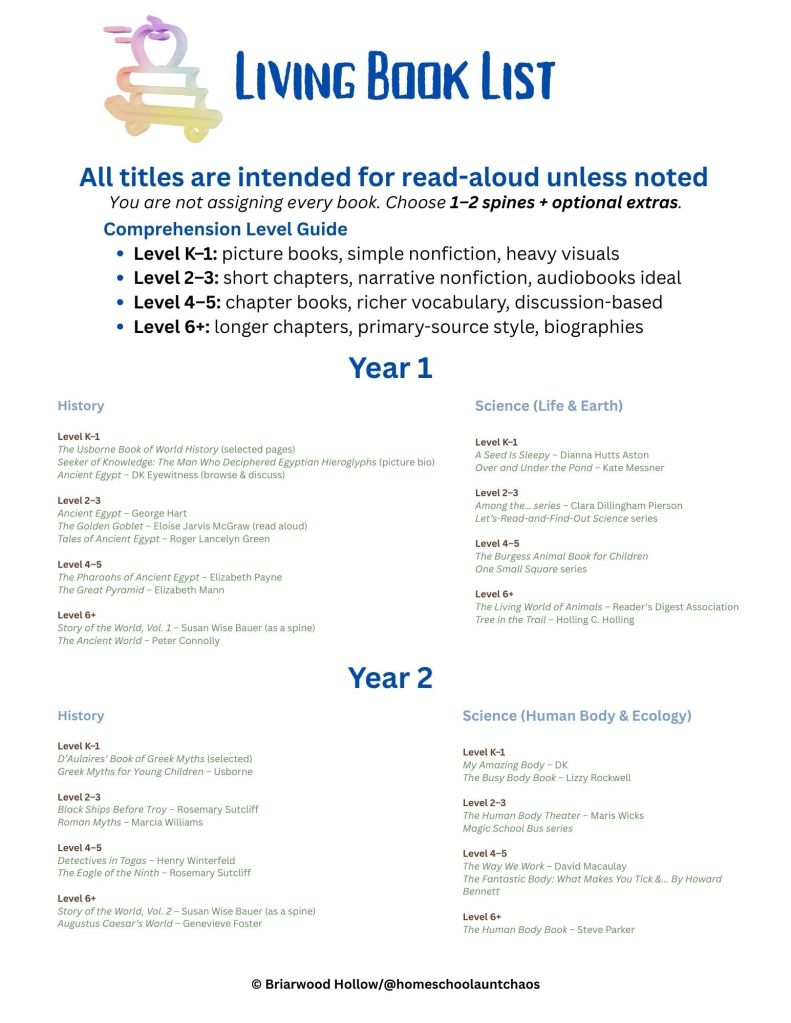
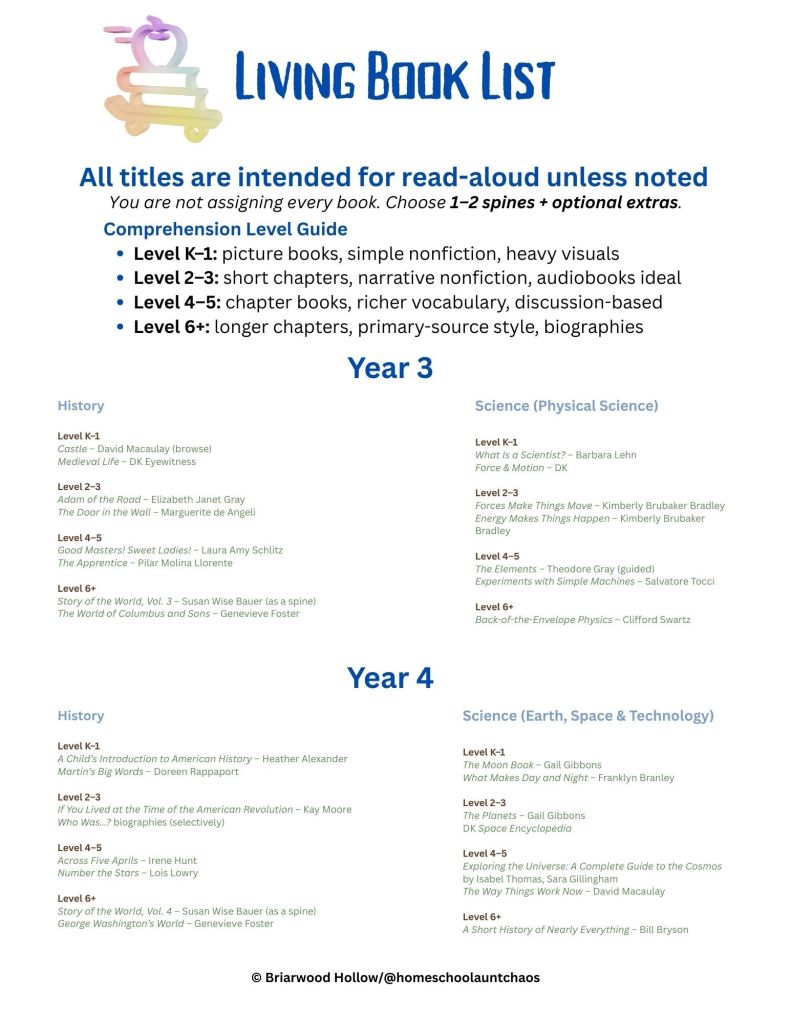
Living Book List

All titles are intended for read-aloud unless noted

You are not assigning every book. Choose 1–2 spines + optional extras.

COMPREHENSION LEVEL GUIDE

Level K–1:

  • picture books, simple nonfiction, heavy visuals

Level 2–3:

  • short chapters, narrative nonfiction, audiobooks ideal

Level 4–5:

  • chapter books, richer vocabulary, discussion-based

Level 6+:

  • longer chapters, primary-source style, biographies

Book Lists

IMPORTANT NOTES

  • Audiobooks are strongly encouraged
  • Picture books are valid at all ages
  • Re-read favorites each cycle
  • One excellent book > many mediocre ones

Living books are meant to be loved, not rushed.

How to use this without overwhelmed

  • Pick 1 history spine + 1 science spine per year
  • Add picture books freely, even for teens
  • Use audiobooks whenever attention or decoding is a barrier
  • Re-read favorites every cycle (that’s a feature, not a failure)

This setup is ideal for children:

  • Dyslexia → oral + audio
  • ADHD → narrative-driven books
  • Autism → predictable themes, repeated exposure
  • Memory challenges → revisiting the same content every 4 years

Briarwood Hollow Curriculum, Charlotte Mason Method, Family-Style Learning, Homeschool, Learning, Uncategorized

Charlotte Mason–Style 4-Year Scope & Sequence

Designed for family-style learning, reusable every 4 years, and adaptable across K–12 comprehension levels

HOW TO USE THIS PLAN

  • One family cycle for History & Science
  • Repeat every 4 years
  • Increase depth, vocabulary, and expectations—not topics
  • All content delivered via read-alouds, discussion, narration, art, and hands-on experiences

Writing, math, and reading instruction are taught separately and individually.

YEAR 1: FOUNDATIONS OF CIVILIZATION & NATURE

History & Geography

Theme: Ancient Civilizations

  • Prehistory & Early Humans
  • Mesopotamia (Fertile Crescent)
  • Ancient Egypt
  • Indus Valley
  • Ancient China
  • Early African Kingdoms

Map Skills:

  • rivers, deserts, continents

Timeline:

  • BCE / CE introduction

Charlotte Mason Practices

  • Living history read-alouds
  • Map tracing with narration
  • Timeline figures (family wall timeline)

Science

Theme: Life Science & Earth Basics

  • Living vs nonliving things
  • Plants: parts, needs, life cycles
  • Animals: habitats, classification basics
  • Food chains & ecosystems
  • Earth: landforms, water, soil
  • Seasons & weather observation

Charlotte Mason Practices

  • Nature walks
  • Nature journals (drawn/oral)
  • Simple observation experiments

Literature

  • Fables
  • Folktales & myths from ancient cultures
  • Poetry: rhythm, rhyme, seasonal poems
  • Oral storytelling & retelling

Fine Arts

  • Art: Cave paintings, Egyptian art
  • Music: Folk songs, rhythm & movement
  • Picture study: ancient art


YEAR 2: CLASSICAL WORLDS & THE HUMAN STORY

History & Geography

Theme: Classical Antiquity & Early Americas

  • Ancient Greece
  • Alexander the Great
  • Ancient Rome
  • Early Judaism & Christianity (historical context)
  • Ancient Americas (Maya, Aztec, Inca)
  • Early trade routes

Maps:

  • Mediterranean, Americas

Science

Theme: Human Body & Ecology

  • Body systems: skeletal, muscular, digestive
  • Health & hygiene
  • Growth & development
  • Biomes & ecosystems
  • Environmental interdependence

Literature

  • Greek myths
  • Roman myths
  • Historical legends
  • Poetry: narrative poems

Fine Arts

  • Art: Greek sculpture, Roman mosaics
  • Music: early classical themes
  • Drama: simple reenactments


YEAR 3: CHANGE, INNOVATION, & CONFLICT

History & Geography

Theme: Medieval to Early Modern World

  • Byzantine Empire
  • Islamic Golden Age
  • Medieval Europe
  • Feudalism & the Black Death
  • Renaissance
  • Age of Exploration

Maps:

  • Europe, Africa, trade routes

Science

Theme: Physical Science

  • Matter & states of matter
  • Simple chemistry (mixing, reactions)
  • Forces & motion
  • Energy: light, heat, sound
  • Simple machines

Literature

  • Medieval legends
  • Exploration narratives
  • Historical fiction
  • Poetry: ballads

Fine Arts

  • Art: Medieval manuscripts, Renaissance masters
  • Music: early composers
  • Architecture studies


YEAR 4: THE MODERN WORLD & THE WIDER UNIVERSE

History & Geography

Theme: Modern History & Civics

  • Scientific Revolution
  • Enlightenment
  • American Revolution
  • U.S. Constitution & government basics
  • Industrial Revolution
  • World Wars
  • Modern global geography

Science

Theme: Earth, Space, & Technology

  • Earth structure & plate tectonics
  • Weather & climate
  • Space: sun, moon, planets
  • Technology & inventions
  • Environmental stewardship

Literature

  • Modern historical fiction
  • Biographies
  • Poetry: modern voices

Fine Arts

  • Art: modern movements
  • Music: modern composers
  • Media & visual literacy


DIFFERENTIATION BY COMPREHENSION LEVEL (QUICK GUIDE)

K–1: listen, point, draw, act out

2–3: oral narration, sequencing cards

4–5: oral + short written responses

6+: discussion, summaries, connections


REUSABILITY NOTE

Each 4-year pass deepens:

  • Vocabulary
  • Discussion
  • Timeline connections
  • Independent thinking

The topics stay the same. The children grow.

Briarwood Hollow Curriculum, Curriculum, Homeschool, Learning

Sensory Specimen Box

What Is a Sensory Specimen Box?

A curated collection of physical items students can handle, observe, compare, and investigate to deepen understanding of academic concepts through sensory input.

Best for:

  • Science & nature study
  • Language arts (descriptive writing, vocabulary)
  • History & geography
  • Special education & neurodivergent learners
  • Inquiry-based and Montessori-style learning

Core Components (All Grade Levels)

Each box typically includes:

  • Specimens (natural or manmade objects)
  • Magnifying glass
  • Observation cards or journal pages
  • Labels or classification cards
  • Optional tools (scale, ruler, tweezers, sound recorder)

Grade-Level Ideas

🟢 K–2: Explore & Describe

Focus: Curiosity, language, basic science

Specimens:

  • Pinecones, feathers, shells
  • Smooth vs. rough stones
  • Fabric swatches
  • Seeds or beans

Activities:

  • Sort by texture, size, or color
  • Describe using 5 senses
  • Draw and label

🔵 3–5: Compare & Classify

Focus: Observation skills, early scientific thinking

Specimens:

  • Leaves from different trees
  • Insect models or exoskeletons
  • Fossils or fossil replicas
  • Minerals

Activities:

  • Create Venn diagrams
  • Measure and record data
  • Write detailed descriptions
  • Introduce taxonomy basics

🟣 6–8: Analyze & Investigate

Focus: Systems, cause/effect, scientific method

Specimens:

  • Igneous vs. sedimentary rocks
  • Animal fur samples (ethically sourced)
  • Soil types
  • Historical artifacts (replicas)

Activities:

  • Hypothesis testing
  • Compare structure & function
  • Cultural or environmental connections
  • Lab-style notebooks

🔴 9–12: Evaluate & Synthesize

Focus: Critical thinking, real-world application

Specimens:

  • Microscopic slides
  • Industrial materials (metals, polymers)
  • Archaeological replicas
  • Forensic samples (fibers, soil)

Activities:

  • Research-based analysis
  • Cross-disciplinary projects
  • Forensic or environmental case studies
  • Technical writing & presentations

Themed Sensory Specimen Boxes (All Ages)

You can rotate boxes by unit:

  • 🌿 Ecosystems Box
  • 🧬 Human Body Box
  • 🏺 Ancient Civilizations Box
  • 🧭 Geography & Cultures Box
  • 🔬 Scientific Tools Box

Adaptations for Sensory Needs

  • Provide gloves or tools for touch-sensitive students
  • Include sound-only or visual-only specimens
  • Offer choice-based exploration
  • Use calming textures or weighted items

Safety & Practical Tips

  • Avoid allergens (nuts, strong scents)
  • Clearly label fragile or sharp items
  • Use sealed containers for biological samples
  • Include a handling guide (with clear instructions)
Briarwood Hollow Curriculum, Curriculum, Family-Style Learning, Homeschool

📍Memory Match

How to Play:

  • Print flashcards in pairs: one with the problem (e.g., 8 ÷ 4 = __) and one with the answer (e.g., 2).
  • Shuffle all cards and place them face down in a grid.
  • Players take turns flipping over two cards.
  • If the problem and answer match, the player keeps the pair and takes another turn.
  • If they do not match, flip the cards back over and the next player takes a turn.

Game End:

  • The game ends when all cards are matched.
  • The player with the most pairs wins.

Memory Match Tips:

  • Start with 6-8 pairs for younger children.
  • Mix addition, subtraction, multiplication, and division for older children.
  • Encourage players to talk through their math thinking while playing.

Flashcards will be shared soon!

Briarwood Hollow Curriculum, Curriculum, Family-Style Learning, Homeschool, Learning

🪖Math Flashcard War

Materials needed:

  • 1 box of flashcards; your choice of addition, subtraction, multiplication, and division (chose one)

How to Play:

  • Shuffle a set of flashcards and divide evenly among players.
  • Each player flips over the top card from their stack at the same time.
  • The first player to correctly answer their own card wins all the flipped cards for that round.
  • If two players answer at the same time, they enter “War!”
  • Each player places three cards face down, then flips the next card and answers. The fastest correct answer wins all the cards.
  • If players tie again, repeat the “War” steps.

Game End:

  • The player with the most cards at the end of the deck wins.

Flashcard War Tips:

  • Start with addition or multiplication only, then mix operations.
  • Set a family rule for how many “Wars” to allow per game to keep it quick.
  • Emphasize sportsmanship, cheering, and learning from mistakes.
Briarwood Hollow Curriculum, Curriculum, Family-Style Learning, Homeschool, Learning

🃏Math Flashcard Speed Rounds Instructions

Materials needed:

  • 1 box of 0-12 flashcards for addition, subtraction, multiplication and division
  • Paper and pencil

How to Play:

  • Set a timer for 30 seconds to 2 minutes based on age.
  • One person calls out flashcard problems quickly.
  • Each player answers aloud as fast as possible.
  • Keep a tally of correct answers for each player.
  • Optional: Repeat 3 rounds and try to beat personal bests.

Speed Round Variations:

  • Addition Only: Quick facts within 10.
  • Mixed Operations: Mix of addition, subtraction, multiplication, and division.
  • Skip Counting: Count by 2s, 5s, 10s, etc. as fast as possible.
  • Dice Speed Round: Roll two dice and add, subtract, or multiply instantly.

Speed Round Tips:

  • Start slow and build up speed.
  • Encourage cheering and clapping for each other.
  • Celebrate personal bests and improvement over time.
Briarwood Hollow Curriculum, Curriculum, Family-Style Learning, Homeschool

🌿 Backyard Habitat

(Bird Feeders, Butterfly Gardens, and Insect Havens)


Phase 1: Plan & Prepare (Days 1–2)

Step 1: Choose Your Habitat Spot

  • Pick a sunny location (6+ hours of sunlight) near some shrubs, trees, or fences for shelter.
  • Ideally, it should be visible from a window so you can watch the wildlife.

Step 2: Observe Your Yard

  • Look for natural windbreaks, water sources, and current wildlife visitors.
  • Note where puddles form (butterflies love damp soil) or areas that get afternoon shade.

Step 3: Measure & Sketch

  • Draw a rough sketch of your backyard.
  • Mark where you can add:
    • Bird feeders
    • Birdbath
    • Native flowers
    • Shrubs or small trees
    • A brush pile or log for shelter
    • Flat rocks for butterflies to sun themselves


Phase 2: Build Bird-Friendly Spaces (Days 3–7)

Step 4: Install Bird Feeders

  • Start simple with 1–2 feeders:
    • Black oil sunflower seeds (attracts many birds)
    • Suet in winter (for insect-eating birds)
  • Hang feeders near trees or shrubs but not too close to give predators hiding spots.

Step 5: Add a Birdbath

  • Use a shallow dish (1–2 inches deep) or purchase a birdbath.
  • Add a rock in the middle for perching.
  • Clean and refill with fresh water every 2–3 days.

Step 6: Plant or Add Shelter

  • Native shrubs, small trees, or even a brush pile provide cover.
  • Stack sticks and fallen branches in a small corner for shelter.


Phase 3: Create a Butterfly Garden (Weeks 2–4)

Step 7: Plant Nectar Flowers

  • Choose native, pollinator-friendly plants that bloom in different seasonsl.
  • Examples:
    • Spring: Milkweed, Columbine
    • Summer: Coneflower, Bee Balm, Black-Eyed Susan
    • Fall: Goldenrod, Asters
  • Planted in clusters of the same type to attract butterflies.

Step 8: Add Host Plants

  • Butterflies lay eggs on specific plants.
  • Example host plants:
    • Milkweed (Monarchs)
    • Dill, fennel, parsley (Swallowtails)
    • Violets (Fritillaries)

Step 9: Create a Butterfly Puddle Spot

  • Fill a shallow dish with moist sand or soil.
  • Add flat rocks for perching.
  • Keep it damp to attract butterflies looking for minerals.


Phase 4: Insect & Small Critter Havens (Week 4+)

Step 10: Build a Simple Bee Hotel

  • Bundle hollow plant stems, bamboo pieces, or paper straws in a waterproof container.
  • Hang in a sunny, sheltered spot.
  • Leave some bare soil nearby for ground-nesting bees.

Step 11: Leave the Leaves

  • In fall, let a layer of leaves remain to provide winter shelter for insects, caterpillars, and overwintering butterflies.


Phase 5: Maintenance & Enjoyment (Ongoing)

Step 12: Keep Feeders & Baths Clean

  • Clean bird feeders every 2 weeks with warm, soapy water.
  • Scrub birdbaths regularly to prevent algae and mosquito larvae.

Step 13: Minimize Pesticides

  • Avoid chemicals that can harm birds, bees, and butterflies.
  • If pests are a problem, try hand-picking or using natural deterrents like neem oil.

Step 14: Observe & Adjust

  • Keep a simple nature journal to track bird and butterfly visits.
  • Adjust your plants and feeders based on what visitors you want to attract.


Optional Hands-On Add-Ons:

  • Build a small brush pile for chipmunks or lizards.
  • Construct a DIY birdhouse suited to local species.
  • Make seed bombs with native wildflower seeds to scatter.
Briarwood Hollow Curriculum, Curriculum, Family-Style Learning, Homeschool, Learning

🌱 Gardening & Yard Planning Family-Style Math Lesson

Focus: Geometry | Area | Perimeter | Multiplication | Real-Life Design


📋 Preparation (Before the Lesson)

  1. Choose a Space:
    Backyard, front yard, a raised bed, or even a large planter box.
  2. Gather Materials:
    • Graph paper or large poster board
    • Ruler, measuring tape, string
    • Markers or crayons
    • Calculators for older kids
    • Optional: Gardening catalogs or seed packets for extra fun
  3. Assign Roles:
    • Youngest: Counting seeds, measuring with string, drawing simple shapes
    • Elementary: Measuring lengths, calculating area, estimating spacing
    • Middle/High School: Full garden layout planning, scaling maps, advanced area/perimeter calculations


🪴 Step-By-Step Family-Style Lesson

🔹 Step 1: Measuring the Garden Space

  • Walk the garden space together with a measuring tape or string.
  • Measure:
    • Length and width of the whole garden (older kids)
    • Count steps or use string lengths for younger kids
  • Record measurements.

💡 Math Talk:

How many feet long is our garden?

How wide?

How would we find the area?

(Length × Width = Area)


🔹 Step 2: Mapping the Garden to Scale

  • On graph paper:
    • Older kids: Draw a scaled garden map (Example: 1 square = 1 foot)
    • Younger kids: Draw the garden and place plants with stickers or stamps
  • Discuss perimeter:
    “How much fencing would we need to go all the way around?”

💡 Family Tip:

Let everyone design their own section of the garden.


🔹 Step 3: Planning Plant Spacing

  • Review seed packets to see spacing needs.
  • Younger kids: Count how many plants can fit in one row.
  • Elementary kids: Calculate how many rows fit in the garden space.
  • Older kids: Multiply to find the total number of plants per bed.

💡 Example:

“Tomato plants need 2 feet between them. How many can we fit in a 12-foot row?”


🔹 Step 4: Calculate Planting Quantities

  • Youngest: Count seeds or starter plants.
  • Elementary: Multiply the number of rows by plants per row.
  • Older kids: Calculate space required per plant, how many can fit in multiple beds, or in a specific area.


🔹 Step 5: Optional Budgeting

  • Look up the price of seeds, soil, and fencing.
  • Older kids can:
    • Calculate total garden cost.
    • Compare prices from different stores.

💡 Family Challenge:

“How could we build this garden on a $50 budget? What can we adjust?”


🔹 Step 6: Build or Prepare the Garden Together

  • Measure again in real life while building.
  • Check if your drawn map matches your real measurements.

💡 Preschoolers:

Can help with digging, watering, and placing markers.


🔹 Step 7: Ongoing Math Extensions

  • Track plant growth with a ruler over weeks.
  • Graph weekly growth rates.
  • Calculate harvest yields per square foot.
  • Budget for future expansions based on this year’s costs.


🌿 Quick Adaptations for Special Needs

  • Visual Tools: Color-coded string, seed spacing diagrams, large print measuring charts.
  • Hands-On Learners: Use bean bags, rocks, or play coins to physically represent spacing and costs.
  • Movement Breaks: Measuring with giant steps, running to collect garden tools between tasks.


🌟 Bonus Family Challenges

  • Design a square-foot garden with exact 12″x12″ sections.
  • Create a companion planting plan using research (what grows well together).
  • Plan a pollinator garden with measured flower spacing.

Family Garden Math Worksheets

Briarwood Hollow Curriculum, Curriculum, Family-Style Learning, Game & Sensory Play, Homeschool, Learning

🍪 Cooking & Baking Math Family Lesson

Focus: Measurement | Fractions | Ratios | Budgeting (optional)


📋 Preparation (Before the Lesson)

  1. Choose a Recipe:
    Pick something simple with multiple measurements like cookies, muffins, pancakes, or soup.
    (Example: Chocolate Chip Cookies)
  2. Gather Materials:
    • Ingredients
    • Measuring cups and spoons
    • Mixing bowls
    • Scale (optional for older kids)
    • Pen, paper, and calculator for older kids
  3. Set Group Roles:
    Assign each child a math-related job based on ability:
    • Youngest: Counting ingredients, pouring, stirring
    • Elementary: Measuring, fraction reading, doubling/halving
    • Middle/High: Scaling recipes, converting units, price calculation


🥄 Step-By-Step Family-Style Lesson

🔹 Step 1: Recipe Review & Math Talk

  • Read the recipe aloud together.
  • Point out:
    • Fractions: ½ cup, ¾ tsp, etc.
    • Units: teaspoons, cups, tablespoons.
  • Ask:
    “What would happen if we doubled this?”
    “What would happen if we halved it?”

Younger Kids: Identify numbers and simple fractions.

Older Kids: Predict how measurements will change.


🔹 Step 2: Hands-On Measuring

  • Let each child measure and pour ingredients.
  • When measuring:
    • Youngest: Count scoops aloud.
    • Elementary: Read fractions on measuring tools.
    • Older: Explain WHY fractions add up (e.g. two ½ cups = 1 cup).

Real-Life Teaching Tip: Use a clear measuring cup to show liquid fractions visibly.


🔹 Step 3: Fractions in Action

  • If the recipe says ½ cup and you only have a ¼ cup:
    • Ask: “How many scoops do we need?”
    • Let younger kids try and older kids explain.
  • Optional: Double or halve the recipe together.
    • Write out the new measurements.
    • Have older children calculate ingredient adjustments.


🔹 Step 4: Ratios & Proportions (for older kids)

  • Talk about the ratio of ingredients:
    • Example: 2 cups flour to 1 cup sugar = 2:1
  • Challenge:
    • If we want to make a double batch, what is the new flour-to-sugar ratio?
      • Does it stay the same?


🔹 Step 5: Real-Life Budgeting (Optional)

  • Let older kids look up grocery prices.
  • Calculate the cost per batch.
  • Bonus:
    “If we sell each cookie for 50¢, how much profit would we make?”


🔹 Step 6: Cooking Time Estimations

  • Ask younger kids to set a timer.
  • Older kids calculate:
    • If each batch takes 12 minutes, how long for 3 batches?


🔹 Step 7: Family Reflection

  • After enjoying the food together, discuss:
    • What math did we use today?
    • Was it easier or harder than expected?
    • What would we do differently next time?
  • Optional: Have each child draw or write a quick note in a math journal:
    • Younger: Draw what they made.
    • Older: Write out the measurements they calculated.


📌 Adaptations for Special Needs

  • Visual Supports: Large fraction visuals, color-coded measuring tools.
  • Hands-on Learners: Use dry rice or beans to practice measuring before baking.
  • Movement Breaks: Set tasks like running to get ingredients or cleaning between steps.


🔥 Pro Tip:

Repeat this lesson regularly with different recipes. Rotate who leads the math each time.

Cooking is one of the strongest, real-world math labs you can offer in your homeschool.

Family Cooking Math Journal