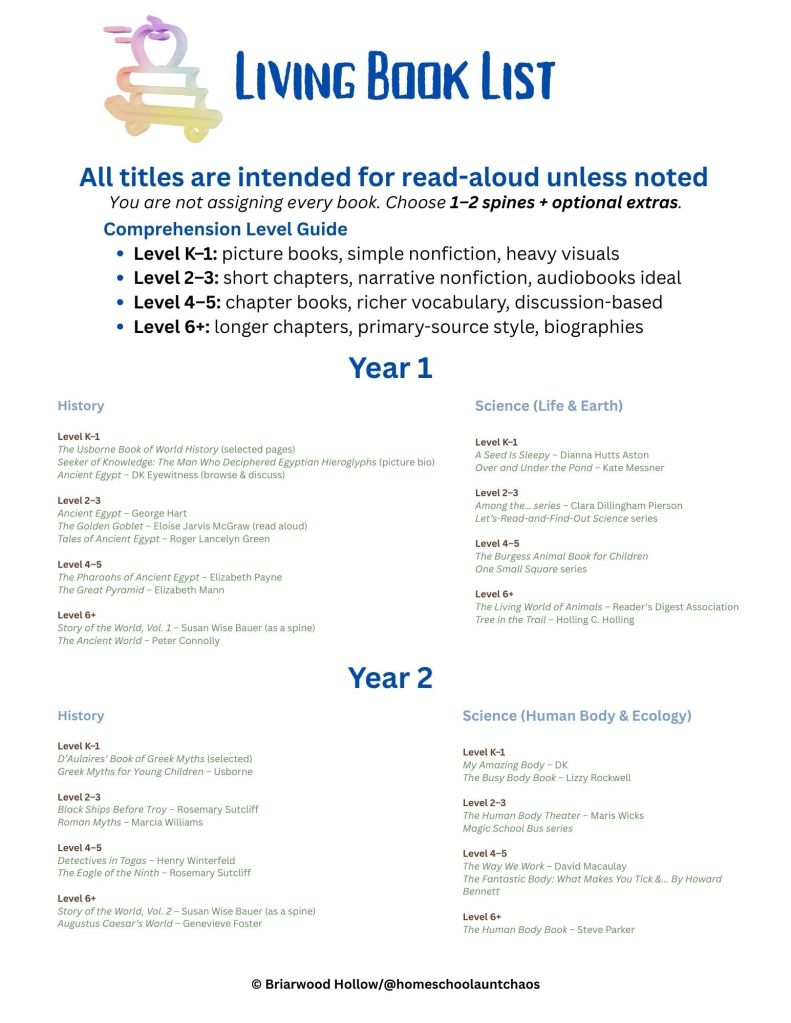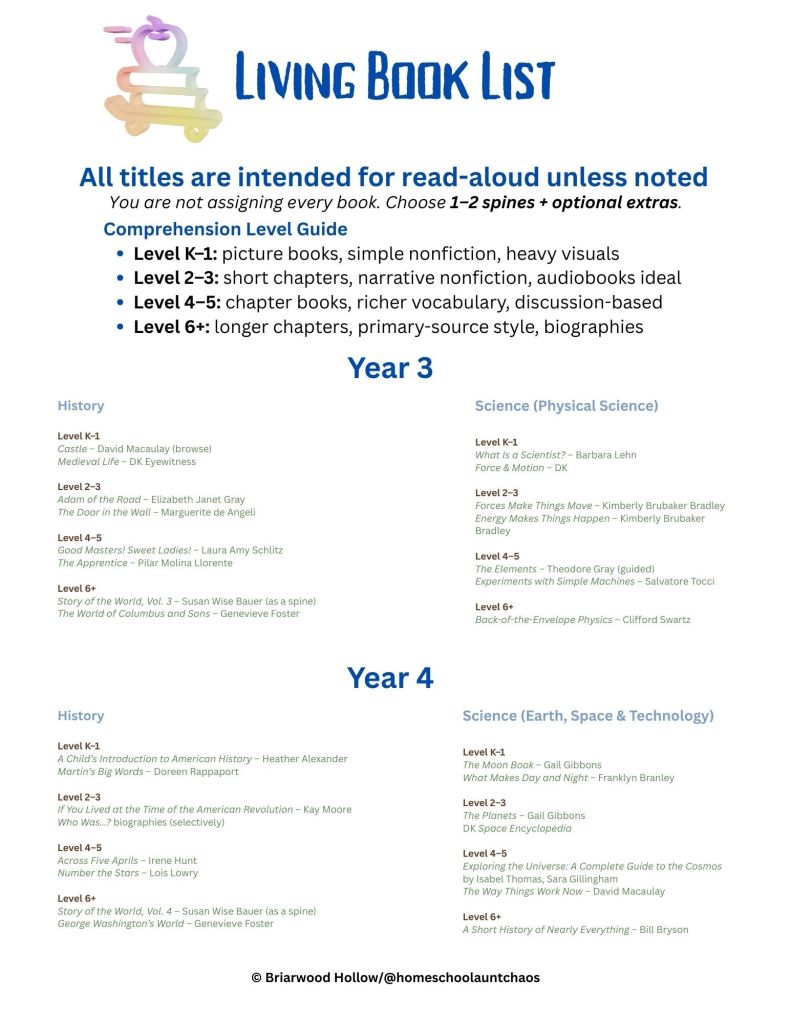
So you are never stuck with a book that doesn’t work
Charlotte Mason–aligned • Neurodivergent-friendly • Guilt-free
THE CORE PRINCIPLE (READ THIS FIRST)
If the book is not producing attention, narration, or connection, it is not doing its job.
A book that flops is not a failure.
It is simply information packaged the wrong way.
You are allowed—required, even—to replace it.
THE 3-NON-NEGOTIABLES OF A GOOD SUBSTITUTE
Any replacement book must meet at least ONE of these:
- Narrative-driven (story, biography, strong voice)
- Visually supportive (pictures, diagrams, timelines)
- Auditory-friendly (audiobook, strong read-aloud flow)
If it meets none → skip it.
WHEN TO SUBSTITUTE (NO WAITING)
Substitute immediately if:
- Eyes glaze over within 5–10 minutes
- Narration produces nothing or distress
- Anxiety or shutdown appears
- You dread opening the book
You do not push through for weeks.
WHAT MUST STAY THE SAME
When substituting, keep the topic, not the book.
Examples:
- Ancient Egypt → still Ancient Egypt
- Body systems → still body systems
- American Revolution → still American Revolution
The book topic stays constant.
The delivery changes.
ACCEPTABLE SUBSTITUTION TYPES (RANKED)
Tier 1: Same Topic, Different Format (Best)
- Picture-book nonfiction
- Graphic nonfiction
- DK / Usborne browsing books
- Short documentary clips (5–10 min)
Tier 2: Same Era or Concept
- Historical fiction instead of nonfiction
- Biography instead of overview
- Single-event focus instead of survey
Tier 3: Read-Aloud Only Exposure
- You read and summarize
- Child listens while drawing or building
- No narration required that day
All tiers count as valid learning.
HOW MANY BOOKS IS “ENOUGH”?
For each topic block:
- Minimum: 1 good book
- Ideal: 2–3 varied formats
- Maximum: Stop when narration is strong
More books ≠ more learning.
THE “48-HOUR RULE”
If a book hasn’t connected after:
- 2 readings or
- 48 hours of avoidance
→ Replace it without discussion.
No explanations to children required.
SPECIAL RULES FOR NEURODIVERGENT FAMILIES
Dyslexia
- Prefer oral + audio
- Written-heavy books are optional
ADHD
- Short chapters > long spines
- Stop mid-chapter if attention dips
Autism & Anxiety
- Predictable structure
- Preview what the book is about
- No surprise questioning
Memory Challenges
- Repetition across formats
- Same topic, different books
SUBSTITUTION DOES NOT REQUIRE:
- Matching reading level exactly
- Finishing the original book
- Justifying your choice
- “Making up” missed pages
QUICK DECISION FLOW
- Is attention present?
- Is narration possible (in any form)?
- Is stress low?
If no to any → substitute.
THE MOST IMPORTANT RULE
The right book makes teaching easier, not harder.
If it makes your day heavier, it’s the wrong book—for now.
You can always come back to it in the next 4-year cycle.
This rule set is designed to protect learning, attention, and your sanity.