Briarwood Hollow Curriculum, Charlotte Mason Method, Family-Style Learning, Homeschool, Homeschool Tips

Book Substitute Rules

So you are never stuck with a book that doesn’t work

Charlotte Mason–aligned • Neurodivergent-friendly • Guilt-free

THE CORE PRINCIPLE (READ THIS FIRST)

If the book is not producing attention, narration, or connection, it is not doing its job.

A book that flops is not a failure.
It is simply information packaged the wrong way.

You are allowed—required, even—to replace it.

THE 3-NON-NEGOTIABLES OF A GOOD SUBSTITUTE

Any replacement book must meet at least ONE of these:

  1. Narrative-driven (story, biography, strong voice)
  2. Visually supportive (pictures, diagrams, timelines)
  3. Auditory-friendly (audiobook, strong read-aloud flow)

If it meets none → skip it.

WHEN TO SUBSTITUTE (NO WAITING)

Substitute immediately if:

  • Eyes glaze over within 5–10 minutes
  • Narration produces nothing or distress
  • Anxiety or shutdown appears
  • You dread opening the book

You do not push through for weeks.

WHAT MUST STAY THE SAME

When substituting, keep the topic, not the book.

Examples:

  • Ancient Egypt → still Ancient Egypt
  • Body systems → still body systems
  • American Revolution → still American Revolution

The book topic stays constant.
The delivery changes.

ACCEPTABLE SUBSTITUTION TYPES (RANKED)

Tier 1: Same Topic, Different Format (Best)

  • Picture-book nonfiction
  • Graphic nonfiction
  • DK / Usborne browsing books
  • Short documentary clips (5–10 min)

Tier 2: Same Era or Concept

  • Historical fiction instead of nonfiction
  • Biography instead of overview
  • Single-event focus instead of survey

Tier 3: Read-Aloud Only Exposure

  • You read and summarize
  • Child listens while drawing or building
  • No narration required that day

All tiers count as valid learning.

HOW MANY BOOKS IS “ENOUGH”?

For each topic block:

  • Minimum: 1 good book
  • Ideal: 2–3 varied formats
  • Maximum: Stop when narration is strong

More books ≠ more learning.

THE “48-HOUR RULE”

If a book hasn’t connected after:

  • 2 readings or
  • 48 hours of avoidance

→ Replace it without discussion.

No explanations to children required.

SPECIAL RULES FOR NEURODIVERGENT FAMILIES

Dyslexia

  • Prefer oral + audio
  • Written-heavy books are optional

ADHD

  • Short chapters > long spines
  • Stop mid-chapter if attention dips

Autism & Anxiety

  • Predictable structure
  • Preview what the book is about
  • No surprise questioning

Memory Challenges

  • Repetition across formats
  • Same topic, different books

SUBSTITUTION DOES NOT REQUIRE:

  • Matching reading level exactly
  • Finishing the original book
  • Justifying your choice
  • “Making up” missed pages

QUICK DECISION FLOW

  • Is attention present?
  • Is narration possible (in any form)?
  • Is stress low?

If no to any → substitute.

THE MOST IMPORTANT RULE

The right book makes teaching easier, not harder.

If it makes your day heavier, it’s the wrong book—for now.

You can always come back to it in the next 4-year cycle.

This rule set is designed to protect learning, attention, and your sanity.
Briarwood Hollow Curriculum, Charlotte Mason Method, Curriculum, Family-Style Learning, Homeschool, Shared Spines, Special Needs Curriculum

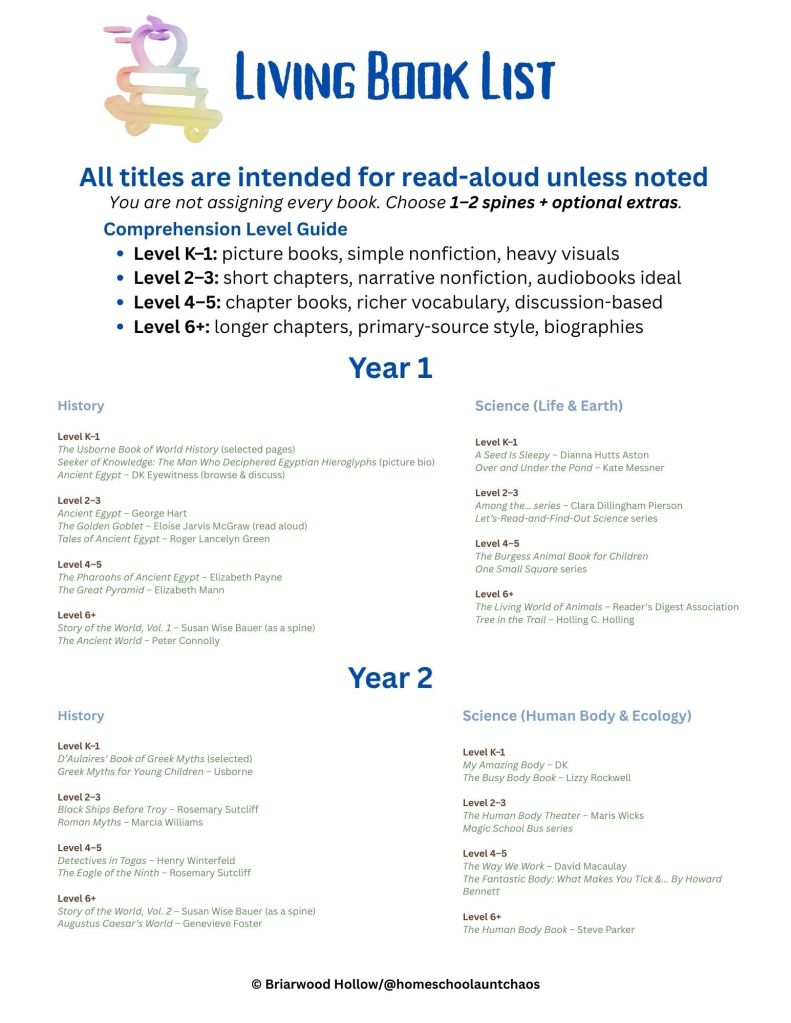
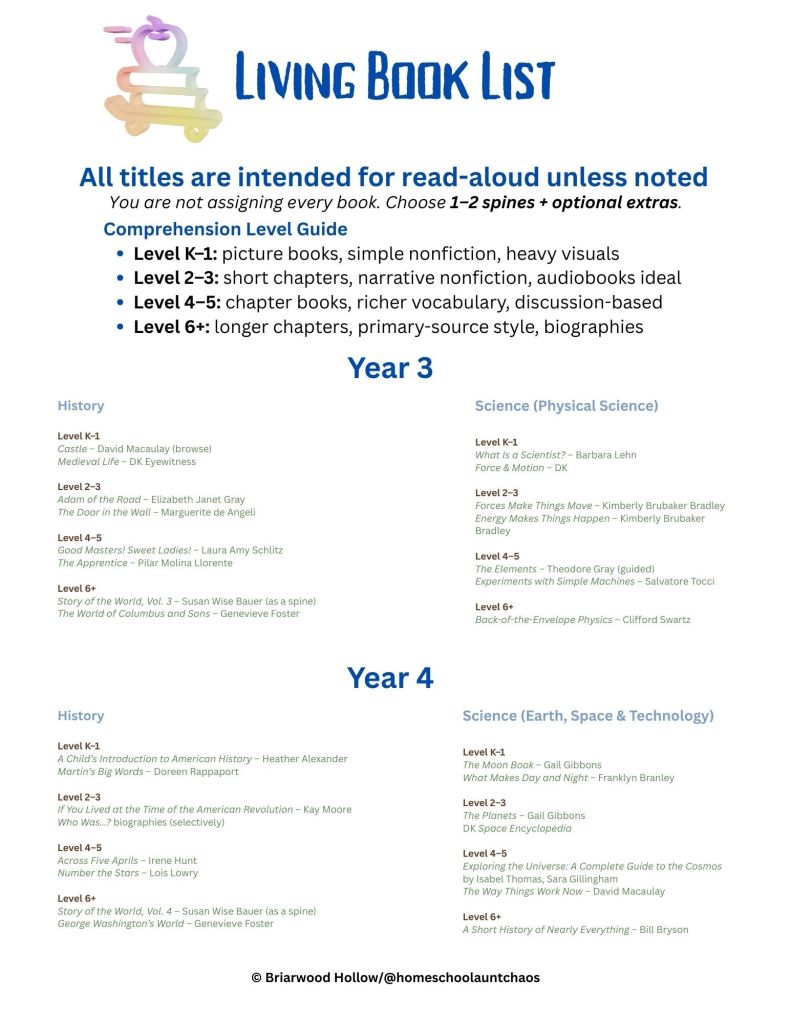
Living Book List

All titles are intended for read-aloud unless noted

You are not assigning every book. Choose 1–2 spines + optional extras.

COMPREHENSION LEVEL GUIDE

Level K–1:

  • picture books, simple nonfiction, heavy visuals

Level 2–3:

  • short chapters, narrative nonfiction, audiobooks ideal

Level 4–5:

  • chapter books, richer vocabulary, discussion-based

Level 6+:

  • longer chapters, primary-source style, biographies

Book Lists

IMPORTANT NOTES

  • Audiobooks are strongly encouraged
  • Picture books are valid at all ages
  • Re-read favorites each cycle
  • One excellent book > many mediocre ones

Living books are meant to be loved, not rushed.

How to use this without overwhelmed

  • Pick 1 history spine + 1 science spine per year
  • Add picture books freely, even for teens
  • Use audiobooks whenever attention or decoding is a barrier
  • Re-read favorites every cycle (that’s a feature, not a failure)

This setup is ideal for children:

  • Dyslexia → oral + audio
  • ADHD → narrative-driven books
  • Autism → predictable themes, repeated exposure
  • Memory challenges → revisiting the same content every 4 years

Briarwood Hollow Curriculum, Charlotte Mason Method, Family-Style Learning, Homeschool, Learning, Uncategorized

Charlotte Mason–Style 4-Year Scope & Sequence

Designed for family-style learning, reusable every 4 years, and adaptable across K–12 comprehension levels

HOW TO USE THIS PLAN

  • One family cycle for History & Science
  • Repeat every 4 years
  • Increase depth, vocabulary, and expectations—not topics
  • All content delivered via read-alouds, discussion, narration, art, and hands-on experiences

Writing, math, and reading instruction are taught separately and individually.

YEAR 1: FOUNDATIONS OF CIVILIZATION & NATURE

History & Geography

Theme: Ancient Civilizations

  • Prehistory & Early Humans
  • Mesopotamia (Fertile Crescent)
  • Ancient Egypt
  • Indus Valley
  • Ancient China
  • Early African Kingdoms

Map Skills:

  • rivers, deserts, continents

Timeline:

  • BCE / CE introduction

Charlotte Mason Practices

  • Living history read-alouds
  • Map tracing with narration
  • Timeline figures (family wall timeline)

Science

Theme: Life Science & Earth Basics

  • Living vs nonliving things
  • Plants: parts, needs, life cycles
  • Animals: habitats, classification basics
  • Food chains & ecosystems
  • Earth: landforms, water, soil
  • Seasons & weather observation

Charlotte Mason Practices

  • Nature walks
  • Nature journals (drawn/oral)
  • Simple observation experiments

Literature

  • Fables
  • Folktales & myths from ancient cultures
  • Poetry: rhythm, rhyme, seasonal poems
  • Oral storytelling & retelling

Fine Arts

  • Art: Cave paintings, Egyptian art
  • Music: Folk songs, rhythm & movement
  • Picture study: ancient art


YEAR 2: CLASSICAL WORLDS & THE HUMAN STORY

History & Geography

Theme: Classical Antiquity & Early Americas

  • Ancient Greece
  • Alexander the Great
  • Ancient Rome
  • Early Judaism & Christianity (historical context)
  • Ancient Americas (Maya, Aztec, Inca)
  • Early trade routes

Maps:

  • Mediterranean, Americas

Science

Theme: Human Body & Ecology

  • Body systems: skeletal, muscular, digestive
  • Health & hygiene
  • Growth & development
  • Biomes & ecosystems
  • Environmental interdependence

Literature

  • Greek myths
  • Roman myths
  • Historical legends
  • Poetry: narrative poems

Fine Arts

  • Art: Greek sculpture, Roman mosaics
  • Music: early classical themes
  • Drama: simple reenactments


YEAR 3: CHANGE, INNOVATION, & CONFLICT

History & Geography

Theme: Medieval to Early Modern World

  • Byzantine Empire
  • Islamic Golden Age
  • Medieval Europe
  • Feudalism & the Black Death
  • Renaissance
  • Age of Exploration

Maps:

  • Europe, Africa, trade routes

Science

Theme: Physical Science

  • Matter & states of matter
  • Simple chemistry (mixing, reactions)
  • Forces & motion
  • Energy: light, heat, sound
  • Simple machines

Literature

  • Medieval legends
  • Exploration narratives
  • Historical fiction
  • Poetry: ballads

Fine Arts

  • Art: Medieval manuscripts, Renaissance masters
  • Music: early composers
  • Architecture studies


YEAR 4: THE MODERN WORLD & THE WIDER UNIVERSE

History & Geography

Theme: Modern History & Civics

  • Scientific Revolution
  • Enlightenment
  • American Revolution
  • U.S. Constitution & government basics
  • Industrial Revolution
  • World Wars
  • Modern global geography

Science

Theme: Earth, Space, & Technology

  • Earth structure & plate tectonics
  • Weather & climate
  • Space: sun, moon, planets
  • Technology & inventions
  • Environmental stewardship

Literature

  • Modern historical fiction
  • Biographies
  • Poetry: modern voices

Fine Arts

  • Art: modern movements
  • Music: modern composers
  • Media & visual literacy


DIFFERENTIATION BY COMPREHENSION LEVEL (QUICK GUIDE)

K–1: listen, point, draw, act out

2–3: oral narration, sequencing cards

4–5: oral + short written responses

6+: discussion, summaries, connections


REUSABILITY NOTE

Each 4-year pass deepens:

  • Vocabulary
  • Discussion
  • Timeline connections
  • Independent thinking

The topics stay the same. The children grow.

Briarwood Hollow Curriculum, Charlotte Mason Method, Curriculum, Game & Sensory Play, Homeschool, Homeschool Tips, Resources, Special Needs Curriculum

Wonder Box

🎁 What is a Wonder Box?

A Wonder Box is a container where children collect small, interesting items found in nature or daily life—a feather, a shiny rock, an old key, a piece of bark, a curled leaf. These treasures become prompts for wonder, questions, art, writing, science, or storytelling.

✂️ Materials Needed:

  • A box with a lid (shoebox, wooden chest, cookie tin, etc.)
  • Optional: dividers (egg cartons, cardboard, small jars)
  • Labels or tags
  • Pen or pencil
  • Magnifying glass or loupe (optional)
  • Small notebook or index cards
  • Double-sided tape or glue (optional for mounting items temporarily)
  • Art or nature journal (optional)

🧰 Step-by-Step Instructions

Step 1: Choose or Make a Box

  • Use any sturdy container with a lid—decorate it together!
  • Let your child name it (“Curiosity Chest,” “Treasure Trove,” etc.) to give ownership.

Step 2: Create a Labeling System

  • Prepare blank labels or index cards.
  • Use these for your child to write or dictate a name, date, and where they found the item.
  • For non-writers: you can write for them or use drawings or stickers as codes.

Step 3: Introduce the Wonder Box Concept

  • Go for a nature walk, neighborhood stroll, or backyard hunt.
  • Encourage your child to collect small items that spark curiosity.
    • Example: “Choose one thing that makes you wonder about something!”

Step 4: Add Found Items

  • When you return, lay items out and talk about each one.
  • Ask open-ended questions:
    • What do you think this is from?
    • What does it remind you of?
    • What do you wonder about it?
  • Let them put their favorites in the Wonder Box.

Step 5: Record Observations

  • Use a notebook, index cards, or nature journal.
  • For younger children or special needs: use sentence stems or visual cues:
    • “I found a ____.”
    • “It feels ____.”
    • “I think it came from ____.”
  • Add drawings, rubbings, or photos.

Step 6: Explore Further

  • Choose an item each week for a “Wonder Study”:
    • Draw it in detail
    • Write a story about it
    • Look it up in a nature guide
    • Do a science experiment (e.g., float/sink, magnify, measure)
    • Match it to a poem, folk tale, or myth
  • For older or advanced learners: research origin, cultural uses, related animals/plants

Step 7: Rotate and Refresh

  • Every few weeks, review the box together.
  • Choose items to retire (move to a keepsake box or nature shelf).
  • Keep the Wonder Box fresh so curiosity stays alive!

💡 Tips for Special Needs Learners:

  • Use tactile items (fuzzy leaves, bumpy rocks).
  • Include a sensory prompt: “How does it smell/sound/feel?”
  • Offer choices with picture cues or actual objects when selecting what to write/draw.
  • Use a visual schedule for the steps.
  • Let them narrate stories if writing is a struggle.
  • Turn it into a matching game (sort by color, size, texture).

📚 Optional Add-Ons

  • Wonder Box Journal: a special book for all recorded observations.
  • Mini microscope or loupe: for closer looks.
  • Field guides or storybooks: to connect their finds to real-world knowledge or tales.

Charlotte Mason Method, Curriculum, Homeschool, Homeschool Library, Vintage Library Collection

Free & Treadwell’s Readers

Reading-Literature: The Primer

Reading-Literature: First Reader

Reading-Literature: Second Reader

Primary Reading and Literature: A Manual for Teachers

Reading-Literature: Third Reader

Reading-Literature: Fourth Reader

Reading-Literature: Fifth Reader

Reading-Literature: Sixth Reader

Reading-Literature: Seventh Reader

Reading-Literature: Eighth Reader

Charlotte Mason Method, Curriculum, Homeschool, Homeschool Library, Vintage Library Collection

Baldwin’s Readers

These are a wonderful little series that works well with the McGuffey’s Eclectic Readers.

The Baldwin Primer: Kindergarten-First Grade

Baldwin School Reading by Grade: First Year

Baldwin School Reading by Grade: Second Year

Baldwin School Reading by Grades: Third Year

Baldwin School Reading by Grades: Fourth Year

Baldwin School Reading by Grade: Fifth Year

Baldwin School Reading by Grade: Sixth Year

Baldwin School Reading by Grades: Seventh Year

Baldwin School Reading by Grades: Eighth Year

Charlotte Mason Method, Curriculum, Homeschool, Homeschool Tips, Notebooking, Special Needs Curriculum

Notebooking

Notebooking is a powerful tool in any homeschool and works extremely well with a Charlotte Mason-style homeschool, especially for special needs learners, because it blends narration, creativity, and ownership of learning. You can easily differentiate notebooking by ability, age, or developmental level. Here’s how to structure it across different levels:

Pre-Writers (Preschool–K, developmental delays, or fine motor struggles):

Focus: Oral narration, drawing, sticker use, light tracing

  • How-To:
    • Let the child tell you what they learned; you write it down verbatim.
    • Encourage drawing a picture from a reading or nature walk.
    • Use stickers or cut-and-paste options (e.g., animals for nature study).
    • Allow tracing of letters, words, or outlines.
    • Keep it short—one idea, one drawing, and a smile.

Emerging Writers (K–1st grade or delayed learners):

Focus: Short, guided writing with drawing

  • How-To:
    • Provide sentence starters: “Today I saw…” or “I learned that…”
    • Let them copy a sentence you wrote from their narration.
    • Include space for a picture with crayons or watercolor.
    • Use mini word banks or labels they can glue in.
    • Expect 1–2 sentences maximum, with lots of encouragement.

Developing Writers (1st–4th grade and up):

Focus: Independent narration with light structure

  • How-To:
    • Offer prompts like: “What happened first?”, “What was your favorite part?”
    • Have them write 3–5 sentences after oral narration.
    • Encourage personal touches: borders, decorations, small diagrams.
    • Mix formats: nature notebook one day, story narration another, picture study response next.

Fluent Writers (5th grade and up, or advanced learners):

Focus: Thoughtful, reflective writing across subjects

  • How-To:
    • Let them choose format: summary, letter, opinion, poem, sketch + caption.
    • Encourage research extensions or mini reports from readings.
    • Teach them to review and revise their own writing lightly.
    • Use narration journals, nature journals, book of centuries, science logs, etc.

Tips Across All Levels:

  • Keep it short and joyful—quality over quantity.
  • Let personality shine—doodles, questions, funny titles are great.
  • Use notebooking pages with visuals, outlines, or templates for support.
  • Build slowly. One good notebook entry per week is enough at first.
  • Remember: Notebooking is about thinking, not penmanship.

I’ll be working on creating a new set of notebooks for the kiddos. Once I get it done I’ll update in another post.

Charlotte Mason Method, Curriculum, Homeschool

The New Augsburg’s Drawing

This is a wonderful vintage collection of Art books.

Augsburg’s Drawing Book 1 (1-3)

Augsburg’s Drawing Book 2 (4-8)

Augsburg’s Drawing Book 3 (4-8 + High School)

Or Individually Graded Books

First Year Book

Second Year Book

Third Year Book

Fourth Year Book

Fifth Year Book

Sixth Year Book

Seventh Year Book

Eighth Year Book