
Science Readers Book I
Science Readers Book II
Science Readers Book III
Science Readers Book IV
Science Readers Book V
Science Readers Book VI
Science Readers Book VII
The World’s Story: A History of the World in Story Volume 1
The World’s Story: A History of the World in Story Volume 2
The World’s Story: A History of the World in Story Volume 3
The World’s Story: A History of the World in Story Volume 4
The World’s Story: A History of the World in Story Volume 5
The World’s Story: A History of the World in Story Volume 6
The World’s Story: A History of the World in Story Volume 7
The World’s Story: A History of the World in Story Volume 8
The World’s Story: A History of the World in Story Volume 9
The World’s Story: A History of the World in Story Volume 10
The World’s Story: A History of the World in Story Volume 11
The World’s Story: A History of the World in Story Volume 12
The World’s Story: A History of the World in Story Volume 13
The World’s Story: A History of the World in Story Volume 14
The World’s Story: A History of the World in Story Volume 15

Frank George Carpenter’s Geographical Readers and more…
Geographical Readers:
Travels Through Asia with the Children
Travels Through North America with the Children
Travels Through South American with the Children
Australia – Our Colonies, and Other Islands of the Sea
Commerce and Industry Readers:
South America, Social, Industrial, and Political
Around the World with the Children
Journey Club Travels:
World Travels:
Alaska, Our Northern Wonderland
The Tail of the Hemisphere, Chile and Argentina
Egypt, The Sudan, Kenya Colony
Australia, New Zealand and Some Islands of the South Seas
The Alps, the Danube and the Near East
Along the Paraná and the Amazon, Paraguay, Uruguay, Brazil
Through the Philippines and Hawaii
Lands of the Andes and the Desert
The British Isles and the Baltic States
New Geographical Readers:
There are a few more I have yet to find.

Sanders’ Union Pictorial Primer
Sanders’ Union Reader: Number One
Sanders’ Union Reader: Number Two
Sanders’ Union Reader: Number Three
Sanders’ Union Reader: Number Four
Sanders’ Union Reader: Number Five
Sanders’ Union Reader: Number Six
Sanders’ School Reader: First Book
Sanders’ School Reader: Second Book
Sanders’ School Reader: Third Book
Format: 4-Day Week
Friday: Catch-up, field trips, hands-on projects, review games, or rest
Time Blocks: Broken into AM and PM Sessions
Core Principles:
🌅 Morning Rhythm (8:30–9:00 AM)
Focus: Calming transitions, grounding routines
🕘 Morning Session (9:00 AM–11:30 AM)
Family-Style Group Time: Everyone gathers together
(With breakout or buddy work for older students)
Time 9:00–9:15
Time 9:15–9:45
Time 9:45–10:15
Time 10:15–10:30
Time 10:30–11:00
Time 11:00–11:30
🍽️ Lunch & Free Play (11:30 AM–12:30 PM)
📚 Afternoon Session (12:30 PM–2:30 PM)
Independent or grade-level work blocks
(Use staggered rotations for 1:1 help with reading, writing, math, etc.)
Time 12:30–1:00
Time 1:00–1:30
Time 1:30–2:00
Time 2:00–2:30
🔁 Rotation Note:
Use “work-with-me” blocks where you rotate through 1–2 students at a time for direct help while others work independently, do hands-on projects, or listen to audiobooks/read alouds.
🌇 Late Afternoon Options (2:30–3:30 PM or later)
Optional or flexible for older students:
🧩 Special Needs Accommodations Built In:
📆 Weekly Subject Rotation for Family-Style Learning
Day 1 –
Group Read-Alouds
Shared Subjects Focus
Day 2 –
Group Read-Alouds
Shared Subjects Focus
Day 3 –
Group Read-Alouds
Shared Subjects Focus
Day 4 –
Group Read-Alouds
Shared Subjects Focus
✍️ Handwriting
Handwriting is defined as the skill of forming letters and numbers correctly, legibly, and fluently. It includes print (manuscript) and cursive styles and is taught through structured practice.
Purpose:
📖 Copywork
Copywork is defined as the intentional practice of copying well-written sentences, poetry, Scripture, or prose from a model onto paper, focusing on accuracy, penmanship, spelling, punctuation, and exposure to quality language.
Purpose:
Copywork is not busywork—it is gentle yet powerful language training.
🗣️ Dictation
Dictation is defined as the practice of writing a previously studied passage from memory as it is read aloud by the teacher, testing the student’s ability to recall correct spelling, punctuation, capitalization, and sentence structure.
Purpose:
Progression:
🌱 Preschool–Kindergarten
Goal: Build fine motor strength, letter recognition, and pre-writing skills.
🔹 Focus:
🔹 Step-by-Step:
🔹 Adaptations:
📘 Grades 1–3
Goal: Master manuscript print, introduce cursive, and begin simple copywork.
🔹 Focus:
🔹 Step-by-Step:
🔹 Adaptations:
📗 Grades 4–6
Goal: Solidify cursive, increase copywork length, and transition into dictation.
🔹 Focus:
🔹 Step-by-Step:
🔹 Adaptations:
📙 Grades 7–9
Goal: Independent copywork and structured dictation with grammar and style awareness.
🔹 Focus:
🔹 Step-by-Step:
🔹 Adaptations:
📕 Grades 10–12
Goal: Apply copywork and dictation toward composition and rhetorical writing.
🔹 Focus:
🔹 Step-by-Step:
🔹 Adaptations:
📅 Weekly Progression (Grades 1–6)
Goal: Build fluent, legible handwriting, internalize strong language patterns, and gently prepare for original writing through daily exposure to excellent literature and careful attention.
Day 1 – Copywork – Guided
Day 2 – Copywork – Independent + Oral Dictation
Day 3 – Copywork or Tracing + Mechanics Focus
Day 4 – Prepared Dictation or Picture Narration
📅 Weekly Progression (Grades 7–12)
Goal: Transition from teacher-directed copywork and dictation into independent mastery of language, grammar, spelling, and style—ultimately preparing the student for original composition and rhetorical writing.
Day 1 – Literary Study + Copywork
Day 2 – Prepared Dictation
Day 3 – Editing + Imitation Practice
Day 4 – Written Narration or Freewriting
Choose from:
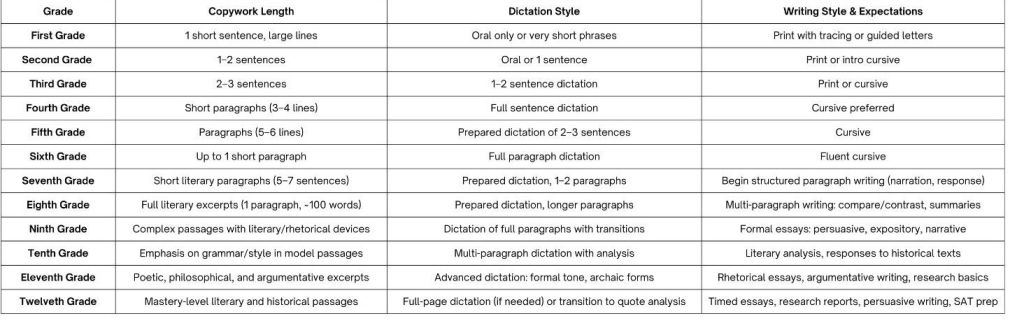
✨ Grade-by-Grade Expectations (Grades 1-12)
A Nature Discovery Basket is a simple, powerful tool for young learners—especially in Charlotte Mason and nature-based homeschools. It’s essentially a curated basket filled with items from the natural world (or related to it) that invite curiosity, observation, and gentle exploration. It encourages hands-on discovery, storytelling, sketching, and imaginative play—ideal for special needs learners who benefit from tactile, visual, and sensory-rich environments.
🌿 What’s in a Nature Discovery Basket?
It can include:
🪵 Step-by-Step: How to Create a Nature Discovery Basket
Step 1: Choose Your Basket
Step 2: Set a Theme (Optional)
Step 3: Gather Nature Items
Tip: Rotate objects seasonally or when interest fades.
Step 4: Add Observation Tools
These tools encourage scientific observation in a gentle, non-pressured way.
Step 5: Include Reading & Drawing Materials
For pre-writers or special needs learners, include:
Step 6: Introduce the Basket
Step 7: Rotate and Refresh
🔍 Bonus: Nature Discovery Basket Themes
This simple basket opens a wide door to wonder, science, language, and calm focus—especially powerful for learners who thrive on sensory, visual, or tactile experiences. Let it be a quiet invitation to engage with the world, not a demand. Nature will do the rest. 🌱